 Reviewed by Li Charmaine Anne
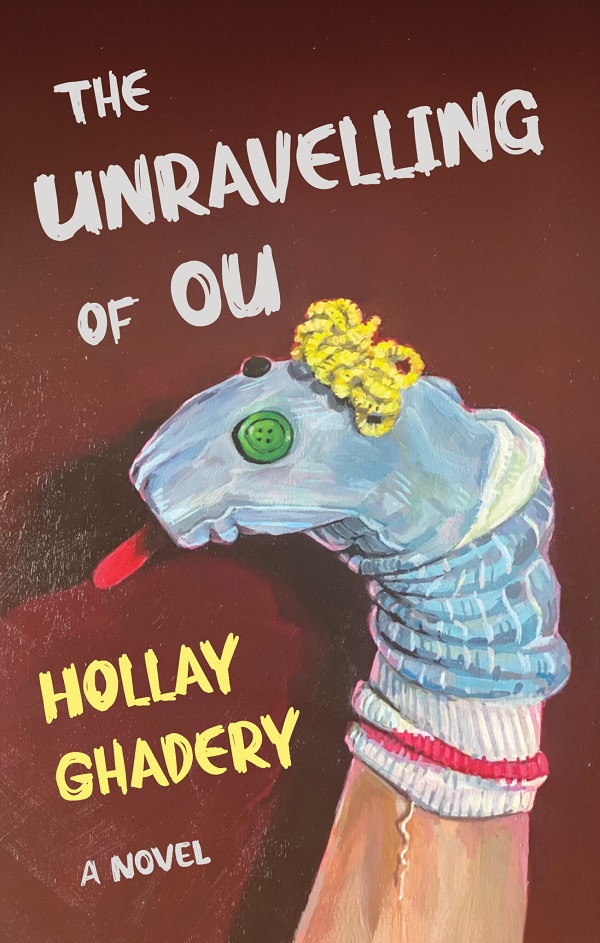
Hollay Ghadery, The Unravelling of Ou (Palimpsest Press, 2026), 200pp., $21.95.
Loss is presumed as we age: the loss of ignorance along with a loss of innocence. Yet across countries, time periods, and generations, a new grandmother retains her childlike wonder—and anxiety—by speaking through a handmade sock puppet, in Hollay Ghadery’s novel The Unravelling of Ou.
Ghadery is a veteran multi-genre writer of Iranian-Canadian heritage living in Ontario, on Anishinaabe land. Poet laureate of her home region, her diverse portfolio includes an award-winning memoir, a short fiction collection, a poetry collection, and a chapbook. The Unravelling of Ou is Ghadery’s first novel, and there is a sense of capstone achievement in this work. The book feels full-fleshed and confident, carrying a weight in wit and wisdom that exceeds what its sleek 173 pages suggest.
The Unravelling of Ou is a first-person narrative told through the perspective of Ecology Paul, a sock puppet that serves as the mouthpiece for the novel’s protagonist, Minoo. When we first meet Minoo, she is running from the scene of a dramatic conflict with her daughter, Roya, who has just given birth. For the rest of the book, Minoo drives around town pondering the choice she must make: surrender the sock puppet or forfeit a relationship with her daughter and granddaughter. It is around the novel’s mid-point that I realize I have never heard Minoo’s own voice in quoted speech outside of that of Ecology Paul.
 Admirable is the book’s ability to pull its reader through a torrent of contradicting emotions: heartbreak and hope, tragedy and humour, oppression and triumph. Yet care must be taken to avoid seeing this story through a binary lens. “Ou,” after all, is the third-person singular, gender-free pronoun in Farsi that Minoo uses for Ecology Paul.
We follow Minoo as she drives with uncertainty. Through conversations with Ecology Paul, who is therapist-like in ou’s speech, Minoo’s backstory emerges through a series of flashbacks. Her early memories in Iran are underlined by an emotionally absent father and a rather misogynistic mother who believes that “[o]ne girl [is] more trouble than ten boys.” Minoo’s mother takes every opportunity to shame Minoo, admonishing her playful nature as counterproductive “silliness,” and ensuring she understands her body’s inherent shame. This menacing pursuit of purity backfires one summer, and Minoo is sent to live with a relative in Canada.
While the journey begins with grief, her auntie in Ontario becomes a sort of sanctuary for Minoo to embark on unprecedented self-discovery. She uncovers a love for theatre, wrestles with feelings of queer passion, and eventually starts a family of her own.
Tumultuous mother-daughter relationships across periods, cultures, and locations are a prevailing theme. Both the relationship between Minoo and her mother and that between Roya and Minoo begin with unmarred idealism, the kind of wonder one feels at the budding of first love. Indeed, “[m]others are gods,” asserts Ecology Paul. “First true loves.” And yet these relationships change, growing more complex and tense as the characters mature.
There are also the non-blood mothers: Cala, Minoo’s aunt in Canada; Judith, Cala’s implied partner; and Mrs. B, a matronly older neighbour keen on sharing her stories. Ecology Paul considers Minoo ou’s mother, and ou’s other parent is Kit, a fellow young immigrant who unwittingly bestows Ecology Paul’s name.
Threading through the lives of the novel’s various matriarchs is another theme of innocence and sin. One memorable scene takes place in Minoo’s early childhood in Iran, when she witnesses a moment of affection between a friend’s parents. In that moment, Minoo learns that in other families, warmth and affection are the norm. With this loss of ignorance comes a loss of innocence, tinged with grief at the family she could have had.
With losing one’s innocence—first menstruation, first pregnancy, first indication that one is too old for bedtime stories—comes a breakdown of the god-like relationship between mother and daughter.
Despite Minoo and her mother’s strained relationship, Minoo occasionally stumbles on pleasant memories with her from early childhood: “The way we are gifted these moments for the short time we are small and soft and good enough to deserve them.” Similarly, Roya views Ecology Paul with genuine wonder when she is small, but as she grows up, her voice becomes more parent-like, more chiding. A sort of role reversal happens within the increasingly fraught relationship she shares with Minoo.
Love, tenderness, and the messiness that inevitably happens when we surrender ourselves to such feelings form another theme that unravels as we journey through the book. Minoo experiences an intoxicating same-sex crush, but she also holds warm affection for male partners. Her marriage is marked by a “companionable grace that has settled” between her and her husband, Atanas. Indeed, the loves we hold throughout our lives offer different energies and hold different spaces without clear superiority or inferiority.
In one of the book’s blurbs, novelist Lindsay Wong describes The Unravelling as a “wildly original” immigrant story, and I agree. The novel transcends the expected narrative that an immigrant story is about the migrating character’s outsider status in their new home. Rather, The Unravelling is about the vexatious otherings that take place within and between parents and children, lovers and ex-lovers, a woman and her sock puppet. While the book nods toward queerness, that facet in particular feels underdeveloped. This is perhaps a testament to the main character’s oppressive upbringing around sexual matters: well into adulthood, Minoo uses childlike slang to describe her genitalia, even in medical contexts.
Perhaps most exquisitely, The Unravelling is a triumph of craft. Each word feels meticulously chosen to carry a precise and compelling purpose. The text is composed melodiously, with rhythmic contours indicative of a master poet’s iterative tinkering. Some poetic (verse-like) formatting is briefly and minimally introduced in the first half of the book. (Unfortunately, it is never seen again.) And despite ornamentation, the writing ventures close but never over the edge into purple prose.
Artfully written, endlessly quotable, and gentle in its provocation, this debut masterwork is a sumptuous ode to those who build us, those we nurture, and the self we become in the process.
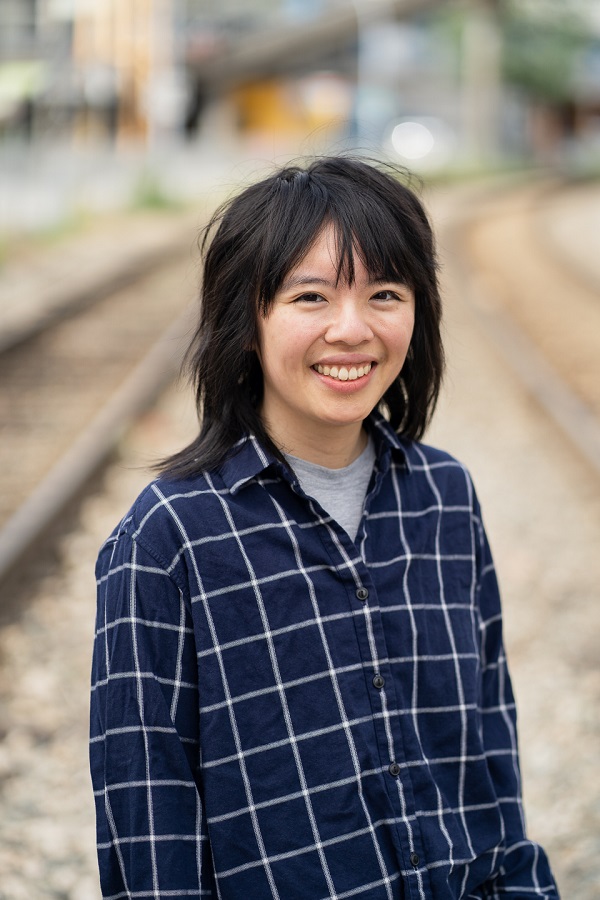
Photo credit: Edward Chang
Li Charmaine Anne (she/they) is a Cantonese diaspora author in the Pacific Northwest. Her debut novel, Crash Landing (Annick Press, 2024) won the 2024 Governor General’s Literary Award in Young People’s Literature – Text, and the Sheila A. Egoff Prize. Shorter works by Charmaine can be found in SAD Mag, The Tyee, Plenitude Magazine, and more. Charmaine gratefully resides on unceded xʷməθkʷəy̓əm (Musqueam), Sḵwx̱wú7mesh (Squamish), and səlilwətaɬ (Tsleil-Waututh) territory.