 Reviewed by Krystale Tremblay-Moll
Daniel Zomparelli, Super Castle Fun Park (Arsenal Pulp Press, 2026), 308pp., $21.95.
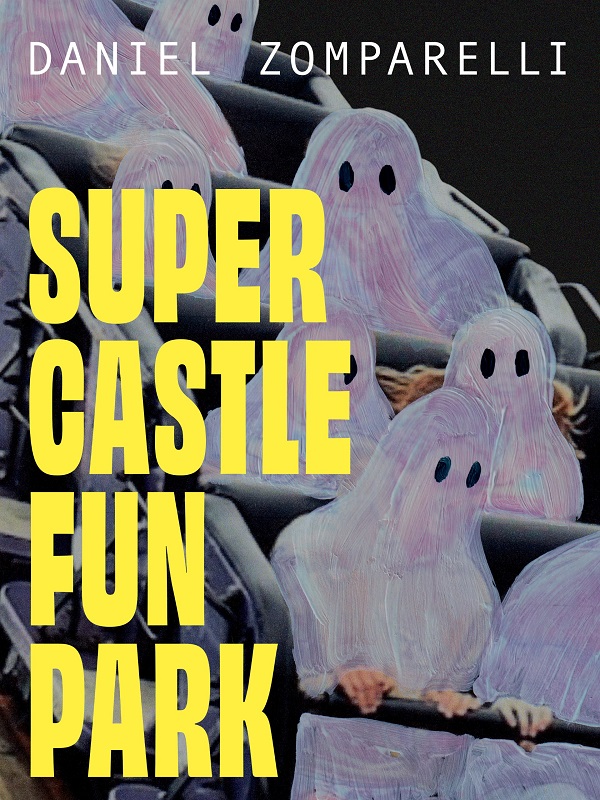
Daniel Zomparelli’s Super Castle Fun Park is a masterclass in juxtaposition: leisure and grief are interwoven in ways that are both surprising and heartrending. Readers witness a patient with terminal cancer riding a Ferris wheel, a gay man drowning his sorrows at Hooters while eating chicken wings, and a community of mobile gamers fighting dragons online while offline they grapple with existential dread. Even the book’s cover captures the novel’s dual tonal registers: tragedy and comedy; the novel’s goofy title, Super Castle Fun Park, is interposed over rows of cartoon ghosts on a rollercoaster.
The novel takes place during the Christmas holidays at a theme park resort that the novel’s Italian-American protagonist, Dario, checks into because it is the closest hotel to his aunt Angela’s apartment. Despite the festive setting, Dario is grieving the impending loss of his beloved aunt, the only remaining maternal figure in his life. Following the interconnected stories of three characters–Dario, his boyfriend Jeremy, and a medium named Chelsea–Zomparelli depicts how the three, as well as a handful of other characters in their orbit, navigate grief, (literal) hauntings, and alienation.
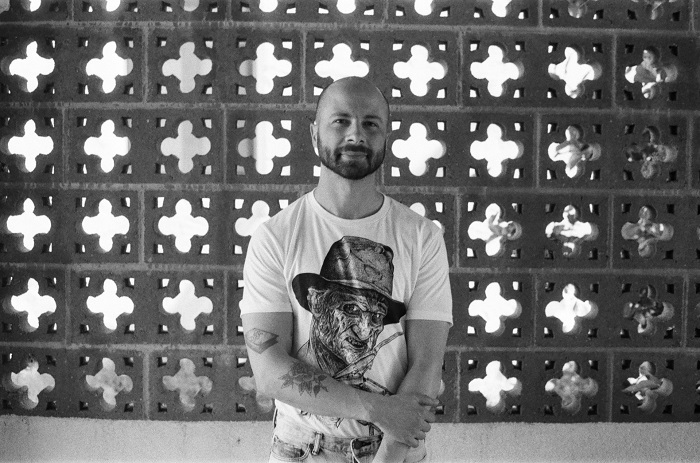 Zomparelli, a Vancouver-born writer who is now based in California, is known primarily for his poetry and his work as co-editor of the collection Queer Little Nightmares. Regardless of genre, a throughline in his work is the combination of stylistic elements from horror and comedy, as well as explorations of queerness and all the ways the digital world creeps into our analog lives.
Super Castle Fun Park, his debut novel, is a dialogue-driven tragicomedy that uncovers the complexity of alienation, particularly its ability to infiltrate even the most joyous and seemingly lighthearted spaces. While in another writer’s hands these topics may have resulted in a depressing and difficult read, Zomparelli finds the right balance between frankness and absurdity. The novel is told from multiple perspectives, among them Dario’s first-person POV and an unnamed third-person omniscient narrator who taps into the lives, dreamscapes, and nightmares of the novel’s dozens of characters.
One of the novel’s most effective humorous elements is the chorus of the dead, whose collective perspective appears at the end of each chapter in response to the various crises the characters find themselves in. “The dead are borrrrrred[,]” they explain after a particularly saddening scene, “The dead want to play a game, we want to crush candy and solve a puzzle and train a dragon and save a woman in distress and build a castle.”
Zomparelli’s prose is vivid, conversational, and filled with instances of dark humour that break the tension created by the novel’s heavy themes. As the narrator aptly explains: “There is something about laughter in times of grief and sorrow; when it comes out, it is spilling from out of a hardened shell. A body can only take so much grief before it needs something else. Like a mustard bottle squeezed hard until the top bursts open and mustard splatters everywhere” (223).
The book’s plot revolves around characters who are all at the brink of reaching that pivotal moment of “burst[ing]” and “splatter[ing].” As such, Zomparelli builds a sense of curiosity in the reader, who will be dying to know how, and if, the novel’s characters will overcome the crushing weight of their pain, and what the catalyst for their healing will be. This growing anticipation gives the novel a powerful sense of forward momentum despite the novel’s brief timeline.
Super Castle Fun Park exists in a magical realist space where there is a mundane, natural order to things that is occasionally disrupted by a touch of the surreal. For instance, ghostly presences are not entirely cause for alarm; the dead are unhinged, obsessed with the “mustard” in your fridge and hedonistic pursuits. Though at times cruel and manipulative, they can be surprisingly nonchalant and even well-meaning. For the characters who see the dead, their presence in the narrative is more of a nuisance than something to be terrified of, despite their ghastly appearance.
Zomparelli’s skill as a writer is at its most striking in these subtle and creative reimaginings of our internal struggles, such as how mental illnesses and neurodivergences are known as the “fog,” “storm,” and “pattern.” The first two conditions are literally tied to meteorological phenomena that encroach and occasionally consume the characters who experience them. He depicts them with a tenderness and empathy that cuts to the core of the pervasive loneliness that plagues (or haunts) contemporary society.
The novel’s most experimental feature is its multimodality; parts of the novel are written in conventional prose while others are written from within the story’s fictional mobile game, a medieval-inspired multiplayer RPG. These sections include both the game’s setups, featuring witches, sasquatches, and dragons, and snippets of the characters’ in-game chat.
Much like the theme park with its “medieval castle tower” rooms and “purple wizard” receptionist, the mobile game is where leisure resides. It is meant to offer an escape from the pressures, responsibilities, and traumas of the real world. Despite losing almost every single round, the characters who play together as a team called the “Round Table Knights” regard the losses in the imagined world as, for the most part, tolerable and contained. Their teamwork is an opportunity to bond with strangers over the internet with whom they establish an easygoing and low-stakes intimacy none can seem to sustain in the real world.
Though “THE GAME,” as it is referred to in the novel, gives the characters a needed escape, it is not as neutral or as harmless as the players would hope. Logging in for a quick round becomes an impulse most of the characters cannot resist, even when it comes to the detriment of IRL connection. Moreover, as anyone who has played mobile games will know, they are addictive and designed to affect the players in much the same way as slot machines do. Players simply looking to shut their brains off for a few minutes find themselves needing to spend money to beat levels designed to only be beaten with paid upgrades. “THE GAME” shares these nefarious features as well. In fact, the commodification of leisure, “fun,” and even wellness is a recurring theme that offers one of the novel’s most ardent critiques: how do we build and sustain connections while protecting ourselves from the profit-seeking forces that facilitate and orchestrate the ways we connect?
 Krystale Tremblay-Moll is a Dominican/Canadian writer and literary scholar based in Montreal. She holds a PhD in Comparative Literature from the University of Toronto. Her writing has appeared or is forthcoming in ASAP/Journal, The Ex-Puritan, and the Montreal Review of Books.