 Reviewed by Drew McEwan
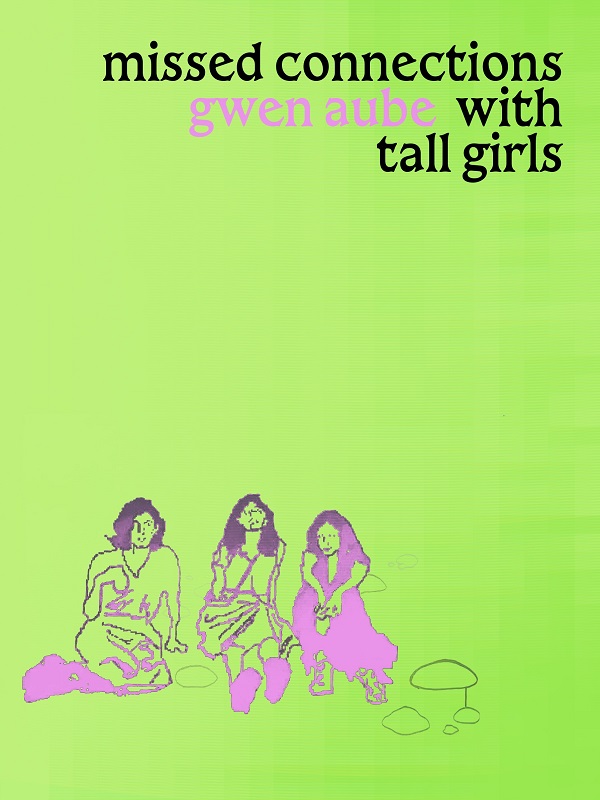
Gwen Aube, Missed Connections with Tall Girls (LittlePuss Press, 2026), 104pp., $22.95.
I mean this as the highest compliment: Gwen Aube’s 2026 poetry collection Missed Connections with Tall Girls is the most t4t (trans for trans) book I’ve ever read. I mean this not in terms of the types of amorousness in the collection, but to whom and for whom it tenderly speaks. Reading these poems, I’m reminded of Torrey Peters’s description of transfeminine t4t community in the story “Infect Your Friends and Loved Ones,” which describes it as “trans girls loving trans girls, above all else… t4t is an ideal… and we fall short of it most of the time” (36). Aube’s poems exemplify this ideal, and in doing so, draw the reader into a beautiful and fraught world of our striving. This is not at all to say that only transfeminine readers will find enjoyment or resonance here — but that, for others, the poetry will lovingly draw them into our experience, language, and community, from the particularities of this experience in queer and working-class community.
A writer based in Montreal, Gwen Aube has previously published the chapbook pulp necrosis (2025) with rob mclennan’s above/ground press. Missed Connections with Tall Girls was released this year by U.S.-based LittlePuss Press, an independent publisher that focuses on trans authors and readers, with an entirely transfeminine masthead including Casey Plett, Emily Zhou, and Cat Fitzpatrick, all of whom are incredible authors in their own right.
Aube’s Missed Connections with Tall Girls articulates the humour, the love, the care, the pain, and the hope of trans life and struggle. In these pages, poetic reclamation of phobic language butts up against crushes, community supports, doctors’ appointments and associated medical gatekeeping, welfare office check-ins, and a devotion to the transfeminine body as holy. With a lyric honesty that belies its formal rigour of taut rhythms and clever sonic play, Missed Connections with Tall Girls offers a compelling and moving lyric investigation into the holiness and banality of contemporary trans life.
Among its navigation of welfare cheques, queer life, and travel around Canada and the U.S., Missed Connections with Tall Girls contains narratives of navigation of the medical system necessary for trans care and livability. One particularly resonant section titled Shemalaise! draws the reader into a neologism that plays on a reclaimed slur for trans women, and the associated madness and dystonia of trans life.
With the exclamation point that shouts the wordplay at the reader, this section begins with an epigraph from right-wing philosopher Nick Land glibly describing transness as a virus. As the section progresses, one poem proclaims, “TRANSSEXUALITY A CEREMONIAL BRANDING, / PHARMACEUTICAL HIJACKING OF THE FLESH … // THE WHOLE BODY BECOMING A CHALICE.” (46). Trans women in speech become holy grail, an object deserving of a quest and worship. This exaltation of the religiosity of transsexual transformation faces the next poem, in which the speaker declares,
sike it’s me i’m the creature
i’m a nasty little freak i shave it all,
on my faggirl shit i bob
& weave about the house (47)
And, later in the poem she declares “i post-op right there on the spot.” Aube’s poetry plays fast and loose with the substance of trans and queer language, transing and queering the grammar and aurality of speech in a way that shows words too are ours to transform to our purposes. This poetry also plays in the highs and lows, the prayers and the slurs. Aube’s poetry is not in the language of normatively palatable affirmation toward liberal inclusivity and validity — but rather is the daily, humourous language of these speakers who stand in the margins, demanding attention and refusing to acquiesce to a cis gaze, sometimes confrontationally so.
In a later poem in Shemalaise! titled “THEY SHOULDA NEVER TAKEN US OFF THE ‘UNFIT FOR SOCIETY’ LIST,” the transfeminine speaker confronts her “sike-a-tryst” (psychiatrist) in order to “convince him i’m other crazy / bitch diseases” (50). to name our experience. As trans life in an ableist, cisheterosexist, and transmisogynistic world comes with attending comorbidities, we often also seek, like this speaker, other forms of mental healthcare for our “other crazy / bitch diseases.”
This medical gatekeeping offers a beneficial route to legitimacy through the validation of medical authority. But our reliance on the psychiatric pathology category opens trans folks up to attack as inherently mad. Aube’s speaker here, as throughout the collection, exists in the struggles of the everyday maddening of trans daily life, and wrestles with these forms of inherent tension in trans life, in the muck of it, “piss[ing] in the dirt” and then consuming the “pissy dirt,” thereby “restarting / my liberation from scratch i’m a modern woman” (50). In this way, the poems of the collection dig into the messiness of trans struggle as a daily series of humiliations, exaltations, and labours.
The language play of Missed Connections with Tall Girls runs on a quick-witted turning of trans-eliminationist rhetoric into a fuel for trans girls’ daily survival. The collection ends with a beautiful ode to trans women, “For Herma.” The speaker asserts: “let no woman be without sister / let no woman see herself a dry tree” (94). Instead, “let rains bless the women / which have made themselves women.” And in this tender coda, Gwen Aube’s poetry sincerely and movingly looks outward toward those of us who are trans women and deserve love and blessings — and to those who are not, who are called on to love and bless trans women in word and action. Reading this homage at the end of Aube’s brilliant collection — which plays in the rhetorical violence, gatekeeping, economic precarity, and exclusion that trans people of all kinds face in 2026 — I found myself crying, experiencing this collection as a beautiful and necessary balm, both transcendent and grounding.
 Drew McEwan teaches in Toronto Metropolitan University’s School of Disability Studies and she is the author of the poetry collections Repeater, If Pressed, and Tours, Variously. Her academic work has appeared in The Canadian Journal of Disability Studies, Canadian Literature, The Journal of Literary and Cultural Disability Studies, TSQ: Transgender Studies Quarterly and the anthology Literatures of Madness: Disability Studies and Mental Health.