 Reviewed by Anne Perdue
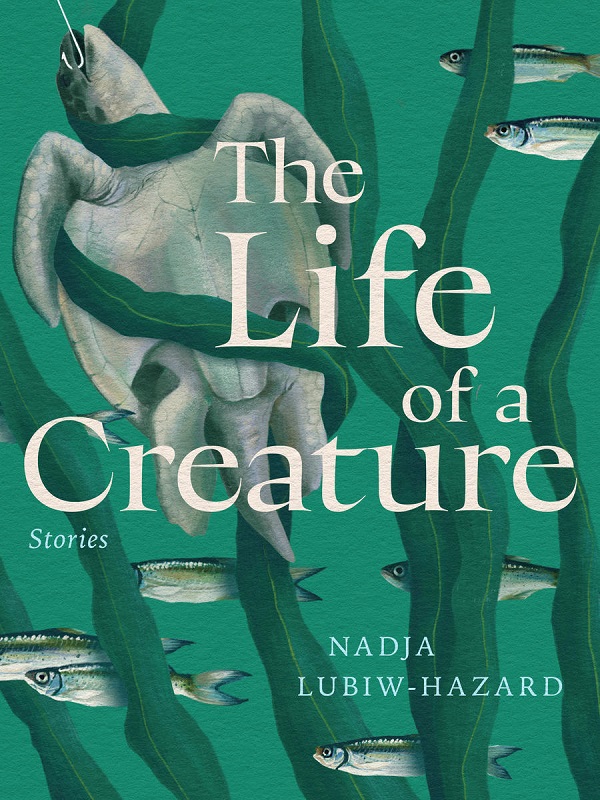
Nadja Lubiw-Hazard, The Life of a Creature (Arsenal Pulp Press, 2026), 208pp., $21.95.
Nadja Lubiw-Hazard is a Toronto-based writer, and author of the novel The Nap-Away Motel and two children’s chapter books. Her latest book, The Life of a Creature, is a bold collection of fifteen short stories. It won the Siskiyou Prize for New Environmental Literature—an award for literary works focused on the environment, animal protections, ecology, and wildlife.
The Life of a Creature is a haunting and disturbing book rooted in a luminous understory. There are many deaths—puppies, kittens, cats, dogs, children, lovers—as well as domestic violence, murder, disease, and cruelty. But there are also acts of kindness, animals rescued, and deep expressions of love. Storylines often do not shift from despair to hope, but rather inch toward understanding and veneration for the interconnectedness of all living forms. As one story, about the destruction of forests and the extinction of wilderness species, eloquently concludes: “And so there was no ending, only the changing, and the blessing, evermore.”
Stories include emotional arcs and the internal lives of humans, but we also enter the sensory and instinctual world of animals. We meet a dog “able to love even with a heart filled with foot-long parasites.” A crow who brings a woman, who rescued it, shiny gifts including a marble, an earring, and a snail’s shell. A bear who’s been in captivity for twenty-three years and is full of longing and an “overwhelming urge to search for something lost.” And another dog who while being beaten to death is able to smell an “electric charge in the air that will bring a thunderstorm later that afternoon.”
 These are moving descriptions. Lubiw-Hazard is an animal advocate and prior to turning to full-time writing she worked as a veterinarian. This experience and insight are no doubt why readers will detect a deep knowing in these stories that gives them an inescapable and erudite authority.
Four of the fifteen stories are told in the first person by Sophie, a vet who is haunted by the accidental death of her young daughter Maddie. The last of these stories, “Turtle Dreams,” contains a series of impressionistic dreams Sophie has beginning with one in which a sea turtle, ensnarled underwater by a fishing hook, transforms into Maddie. In another, when Sophie announces she has to go rescue Maddie, a woman warns her: “It’s too late.” When Maddie slips into the water at a riverbank, Sophie’s brother’s dog speaks to her: “You can’t save her,” he says. “Or them,” he adds. It isn’t clear, who exactly them is. Sea turtles perhaps. But it captures the overwhelming desire to fix things, to save creatures, to protect the innocent—children, pets, friends, lovers—that runs throughout the book.
Another recurring theme is a debilitating darkness that people, especially children, can be forced to carry through life if they have borne witness to acts of violence, destruction, and cruelty. “The Things We Left Behind” explores the “terrible burden of our collective damage” that six sisters, who grow up in a violent home with a physically abusive father, carry into their adult lives. There’s rehab, breakdowns, and rage that’s twisted up “with the betrayal that made us skittish, like feral kittens hissing at a tender hand.”
Similarly, “What Dwells Within” captures a world in which three young girls become aware of the monstrous and macabre underside of life when they discover a suitcase in a ravine. Inside it they find a neighbour’s dog, bloodied and dead, wearing a string of shiny white pearls and a short pink nightie.
In “Captive,” a boy who is bullied at home and at school visits a polar bear at the zoo. Disappointed by the bear’s lack of energy he throws a rock at it. Eager to show he’s not a coward, he then jumps the fence into the animal’s pool where he meets a gruesome death.
Stylistically, Lubiw-Hazard’s does not shy away from horror but does not indulge in excessive description. Sentences and scenes tend to be short and precise. The storytelling has energy and flow. Despite the amount of trauma, loss, and grief contained in this book, there is a strong emotional glide to these stories. And a timelessness. They are not concerned with current political or social trends, but rather the horrifying imbalance that results when living beings are abused. Several of the more harrowing stories in the collection, including “What Dwells Within” and “Captive,” are based on real life events.
The book begins and ends with stories that share a similar perspective. In the eponymous opener, “The Life of a Creature,” each paragraph begins with two words. A puppy. A dog. A cat. A pigeon. A rat. And so on. Some of them die, some are saved. Time passes, the narrator becomes pregnant and her dog dies just before she gives birth to a baby boy. It concludes with the new parents burying their recently deceased dog along with the mother’s placenta in an apple orchard, along with their sorrow, joy, and the “hope that they will grow, that they will nourish some small, sweet red apples.”
In the last story in the collection, “River’s Wake,” River, a thirty-seven-year-old free spirit, meets his terminal diagnosis of pancreatic cancer with a desire to follow the customs practiced in parts of Africa and India, where the dead are not buried but are left above ground for the hyenas and vultures. His partner Mel, who has always loved River’s fearlessness, is horrified by this idea. River insists that we’re all part of the food chain. “We all die and decompose, turn back to dirt, to dust, to earth.” And he pleads: “Isn’t that what the very nature of life is, always changing, always becoming and unbecoming?”
Both stories embrace the ambiguity of emotions. As the narrator in “The Life of a Creature” thinks to herself: “All the grief and all this wonder, it makes up a life, a good, good life. Ah, but I loved him, my dog Orpheus, I loved him, and now my heart has broken open again.” And Mel, in “River’s Wake,” asks herself how many emotions can one person feel at one time? She imagines she has “one mouth howling with joy, one with fear, one with rage.”
In the “The Art of Dying,” a character describes reading Zora Neale Hurston’s book Their Eyes Were Watching God, and says: “I’d never read a book like that before. It woke me up to the world, to all its heartache and tenderness. And it taught me to be defiant.”
These words could be a fitting description for the experience of reading Lubiw-Hazard’s book. It is not an easy read but despite all the darkness the overall effect is a shimmering reminder of the beauty and the sacredness of all life on earth. In these times when our world seems bent on self-destruction, The Life of a Creature is a collection of stories the sum of which makes you want to be, dare I say it, defiant? Yes!
 Anne Perdue’s collection of short fiction, I’m A Registered Nurse, Not a Whore, was longlisted for the Frank O’Connor International Short Story Award and shortlisted for the Relit Award. She works as a Senior Editor for the Metcalf Foundation and currently lives in Vancouver.