 Reviewed by Eva Crocker
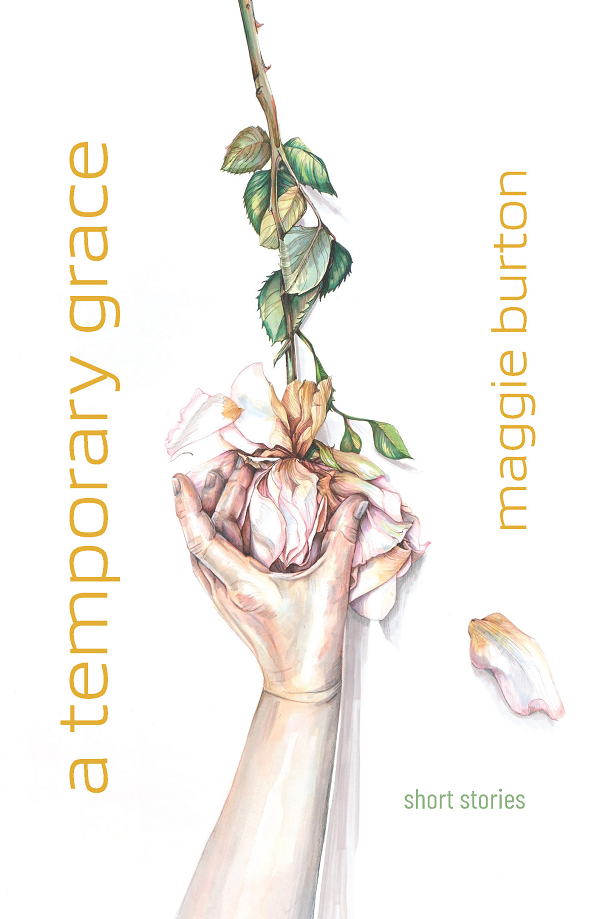
Maggie Burton, A Temporary Grace (Breakwater Books, 2026), 220pp., $22.95.
Maggie Burton’s short story collection A Temporary Grace grounds big questions about how technology is changing the way we relate to each other in a refreshingly contemporary St. John’s. Her descriptions of the physical landscape of the city are precise in a way that is deeply satisfying to a reader who knows it well—and will bring it to life for readers who’ve never been to Newfoundland.
Many of the stories are set in the recent aftermath of the COVID-19 lockdown, and the characters are recovering from mental-health struggles that have been aggravated by the isolation of the pandemic. The collection captures the way a small city can feel at turns lonely and suffocating. Many of Burton’s characters go online seeking a feeling of connection that isn’t otherwise available to them. Some find themselves using social media to lure marks and potential lovers under false pretenses.
The short story “systems thinking” begins with the protagonist, Nikki, worrying she’s in trouble for turning her camera off during an endless Zoom meeting hosted by a cult-like organization called the Project. Nikki has been indoctrinating Newfoundland and Labrador–based small-business owners into the Project, which she comes to understand as a nefarious scam. The story does an excellent job of capturing a particular brand of contemporary pseudo-feminism that pairs self-help lingo with ruthless capitalist rhetoric (think ). One of Nikki’s recruits is a woman who grows mushrooms for both fancy restaurants and the legal magic-mushroom industry.
Burton writes, “Nikki brought her into the Project to try and develop synergies with a local vegan-leather craftswoman. It was a good idea, and a testament to Nikki’s success as a social innovator.” This story takes a noir turn as Nikki goes undercover to expose the Project’s insidious motivations. It is a bit of a genre anomaly in the collection and feels like Burton flexing her impressive range as a writer.
Several stories in the collection follow characters who struggle with not feeling understood by the people in their lives and so turn their attention to online dating. A story called “a dog for jennifer” is told from the perspective of personal trainer Steve, who seems genuinely unable to understand why many of the women he hooks up with feel violated by him. Further, because Steve dates women with whom he doesn’t share any connections in real life, he rarely faces the consequences that typically come with treating someone badly when you share friends or coworkers.
This story is an especially damning portrayal of how the internet shapes our relationships; we have the sense that because these women’s initial interactions with Steve took place online, they failed to pick up on signs that might have helped them recognize him as a potentially dangerous person. It is uncomfortable to be forced to see the world through Steve’s eyes for the duration of the story. When Steve’s date asks for a well-done steak, the narrator says, “He knows from experience that young people don’t know how to eat things the right way.” This line subtly betrays Steve’s misogynistic condescension and his disturbing pattern of seeking out women who are younger than him.
In “hell together” and “spiders,” new mothers get on the apps hoping queer dating will offer an alternative to the violence and coercion they associate with dating men. Katie, the single mom at the centre of “spiders,” is pushed to get back in the game by her best friend, who says about dating women “That way… it’s safer to have people over when Jaclyn’s asleep.” However, Burton does not indulge essentialist tropes about gender, and these protagonists find that lesbian dating presents its own unexpected challenges.
I appreciate that Burton refuses to validate the fallacy that women are inherently more empathetic or instinctually better communicators, and therefore queer relationships are “easier.” However, my favorite story in the collection is “marty and the rat,” in which two women do share a moment of genuine emotional and carnal connection. Marty, a severely depressed woman who lives alone, uses a rat problem as an excuse to invite herself into the home of her new neighbour Geraldine, a single mother of three.
Marty’s neighbour misinterprets her desperate bid for companionship as a come-on and the two end up sloppily making out in the kitchen while the kids sleep upstairs. Just before they kiss, the narrator tells us:
They stand there, an entire universe of experiential difference hanging between them like earth and a quasar. On one side, Geraldine has three kids and family drama. On the other side, Marty has a lifetime of experience with clinical depression and what Geraldine has just termed the morbs. They stand there quietly, looking at each other’s faces. Would it be possible to bridge the gap, to connect the worlds?
Moments later, Marty
…slams down her shot glass and says, simply, “Fuck it.” She reaches over and pulls Geraldine into her body, holding her in a quick, tight embrace. She lets go and reels backwards and bangs her spine off the lip of the countertop. The room spins a bit.
Geraldine stands there for a second. Then, charging at Marty, she slams her lips into Marty’s lips and shoves her tongue into Marty’s mouth.
Earlier in the story Marty reflects that she sometimes, “…can’t tell if she’s attracted to women because she likes them or because wishes she looked and felt like a normal woman.” Yet the sexual reawakening she experiences when Geraldine reaches down the front of her jeans and “cups her vulva like a hamster” is deeply embodied.
The visceral connection Geraldine and Marty share is especially impactful because Burton captures tech-fueled alienation so convincingly elsewhere in the collection. Perhaps it’s significant that this moment of unexpected eroticism and the tenderness that follows come about because Marty forces herself to knock on a new neighbour’s door and introduce herself; seeking the type of spontaneous in-person relating with a stranger that feels harder to come by in the age of smartphones.
Newfoundland is often depicted as existing within a romanticized version of the past—think of the tourism commercials that show clothes flapping on the line in a pristine rural community, followed by drone shots of undeveloped coastline. So Burton’s choice to explore themes that belong definitively to this decade, in the context of the island’s very recent past, makes this collection an exhilarating addition to Newfoundland’s literary landscape.
 Eva Crocker is the author of the short-story collection Barrelling Forward and the novels All I Ask and Back in the Land of the Living. She holds a PhD in Interdisciplinary Humanities from Concordia University, where she researched visual art responding to resource-extraction projects in Newfoundland and Labrador. Her new short-story collection, Bargain Bargain Bargain, will be published by McClelland & Stewart in 2027.