A Q&A with L’Amour Lisik, Plenitude Magazine
In collaboration with the annual Victoria Festival of Authors taking place October 12 to 18, 2026, former Plenitude prose editor L’Amour Lisik interviews VFA panelist Daniel Zomparelli, who will participate in Amusement Dark: Three Novels, an in-person conversation with three novelists whose new books combat life’s darkest experiences with humour, the surreal, and even the supernatural.
Daniel Zomparelli (he/him) is the author (and/or co-author) of three poetry collections. His short story collection Everything Is Awful and You’re a Terrible Person won the ReLit Short Fiction Award. He co-edited Queer Little Nightmares with David Ly. Born and raised in Vancouver, he now lives in Glendale, CA.
Super Castle Fun Park explores relationships, grief, mental health, and the role technology plays in how we view ourselves in the earnest, moving, and darkly funny voice. Unexplained (or unexplainable) ghosts and monsters (or monstrous people) emphasize the ways in which fear, desire, and trauma inform and test our humanity. Daniel Zomparelli, who will participate in Amusement Dark: Three Novels, an in-person conversation with three novelists whose new books combat life’s darkest experiences with humour, the surreal, and even the supernatural.
L’Amour Lisik (LL): You’ll be a panelist alongside Doretta Lau and Anakana Schofield at the VFA’s Amusement Dark: Three Novels moderated by Matthew J. Trafford on October 17. What are you most looking forward to discussing with these other novelists?
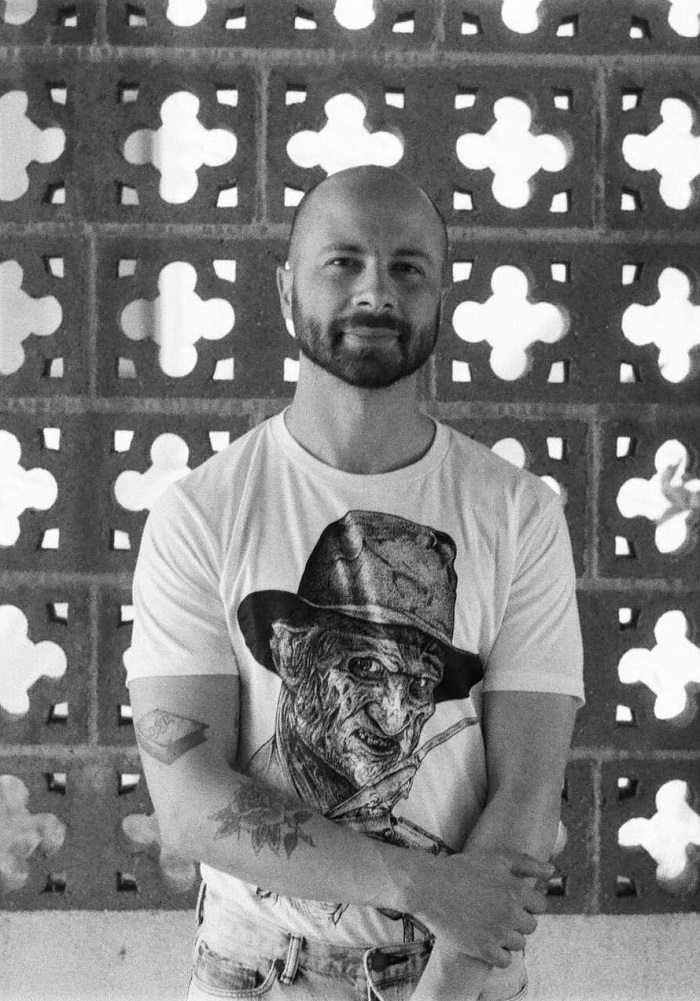
Photo credit: Gabe Liedman
Daniel Zomparelli (DZ): I’m in such great company and I am lucky enough to call all these writers my friends! I’m excited to delve into the similar themes of our books. I’m currently reading Doretta and Anakana’s books, and look forward to asking them too many questions and throwing so many compliments at them.
LL: In your debut novel, Super Castle Fun Park, loss, loneliness, and mental illness sit side by side with humour. What draws you to these themes? How do you balance dark humour and hope with characters facing grief, isolation, and debilitating mental illness?
DZ: As someone who has and continues to deal with grief, isolation and mental issues, it is easy to draw upon these themes. I always found solace in laughter and humour, so it feels important to balance the two. They don’t exist outside each other, but in fact work together to allow us to move forward from all of the dark times. The hardest I have laughed has been when I was at my lowest. I want to respect that dichotomy in my writing.
LL: Super Castle Fun Park dips in and out of several voices and settings—real, online, and supernatural. The main character’s story is cut with a chorus of ghosts, THE GAME’s quests and conversations, and glimpses into other THE GAME users’ lives. How did you land on this mode of storytelling? Which part of the puzzle came first when you began to write?
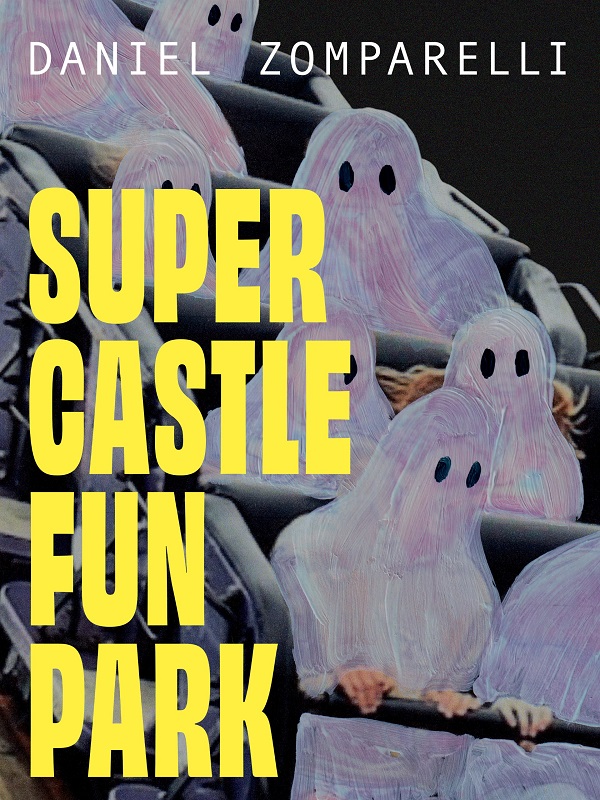 DZ: I started this book with a general concept of suburban castles. I had been playing a castle game on my phone with a bunch of strangers and I kept returning to this idea of castles in America, how capitalism reimagines kings and queens through monetary gain. And this was very transformed by a couple of nights in a hotel I was staying at while taking care of my godmother who had stage 4 cancer. The hotel had this waterpark, and the only place nearby for food was a small snack stand serving pina coladas, or a mile away was an Arby’s. It all kind of built from there. What it would be like to have to stay in a place of amusement when you’re dealing with something as difficult as I was at the time. From there it all snowballed. I kept expanding the story, expanding the characters playing the game. Because I also have a hyperfixation on themes, I began researching castles and reading the classics. I’m sorry, I’m rambling, but it then brought me to the Excalibur which is the ultimate artifice of a castle. It all started to click, like a puzzle. After a while, I was reading more and realized a chorus would help propel the story, and who better than the dead to vocalize that.
LL: As the founder of your own literary magazine and as a contributor to lit mags and anthologies throughout your career, what advice would you give to emerging writers looking to get published? Can you talk about your first ever publication and your most recent one?
DZ: My best advice for those starting out, is to get a bit administrative with your submissions. I had an excel sheet that tracked future publishing deadlines and their themes. While I was writing and having fun with my work, I would set aside time to look at any of the publication themes and see if anything fit. It really worked out and I had a good success rate of publishing. It’s a lot of work, but keeping your writing space to be creative, and making sure to spend time being focused on administrative made it feel like less of a daunting task.
LL: You’ve now published poetry collections, a short fiction collection, and a novel. What draws you to write poetry versus fiction, and long fiction versus short fiction? What limitations, if any, does each genre impose on you, and what avenues do they open for the themes you want to explore?
DZ: I tend to start with an idea or concept and then I try out which genre will work for it. I’ve had poems turn into short stories and stories turn into novellas. I kind of let the work sort itself out over time. Poetry allows me to be more vague, more complicated in my intention. Whereas a novel, I have to be more clear so that the reader can follow the plot. But I also like mixing genres and styles in every book so sometimes you’ll find poetry in the fiction and fiction in the poetry. It makes me work deeply unpopular, but I’ve always known my writing isn’t for everyone. Once a weirdo, always a weirdo!
LL: Are there any other VFA panels or events you’re looking forward to attending, either online or in-person?
DZ: Sadly I am just travelling in for the event on October 17th directly from Calgary’s literary festival. If I was able to, I would really love to go to “Beyond Gratitude” on the 12th of October, “Stories in Relation” on the 13th, and I love Jordan Abel so “How Stories Breathe” on the 15th would be a must see.
LL: Who or what informs your writing? What’s on your to-be-read list? What creative projects are you planning or working on right now?
DZ: I’m allowing myself a break from writing at the moment because writing can take a lot of energy out of me. I do have a couple film scripts that me and my husband are tinkering with, and hoping that is my next focus. I still hope to write a memoir in essays about Hallmark Christmas movies, but that’s a lifetime project. I am absolutely not joking about this, for those who don’t know me.
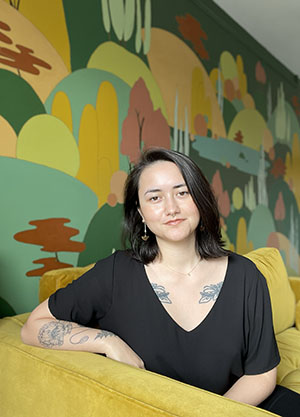 Interviewer Bio: A queer writer of Chinese, Mauritian and Scottish settler descent, L’Amour (she/they) lives and works on the unceded traditional territories of the Lək̓ʷəŋən and W̱SÁNEĆ Peoples, where they are the managing editor of the The Malahat Review. They are also the former Associate Prose Editor at Plenitude Magazine.