 Reviewed by Eva Crocker
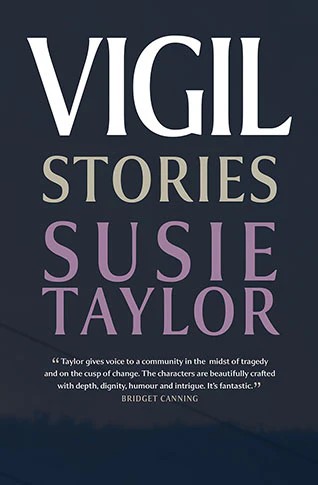
Susie Taylor, Vigil (Breakwater Books, 2025), 248 pp., $22.95.
Susie Taylor’s award-winning collection of linked short stories, Vigil, is groundbreaking in its subtle queering of rural Newfoundland. The collection opens with a piece from the perspective of the fictional small town of Bay Mal Verde. The stories that follow move fluidly between the perspectives of different residents of the town, all of whom have a connection to a young man named Stevie, who has disappeared. Each installment in the collection is an expertly crafted short story capable of standing on its own while also contributing to the larger narrative of the book as a whole.
Taylor’s portrayal of out-port life addresses difficult subject matter like violence and addiction with nuance, humour, and moments of intense beauty. Like Joel Thomas Hynes’ 2004 novel Down to The Dirt, Taylor depicts a grittier and more contemporary rural Newfoundland than you see in the tourism ads. In Bay Mal Verde, there are more broken-down vehicles on people’s lawns than pristine laundry flapping on their clotheslines; however, there are also vibrant lupins blooming in the ditches. There is the evocation of leaked nudes and arson and there are violent drug dealers. Those same drug dealers and arsonists dote on their mothers, believe in shoveling their elderly neighbours out, spoil their pets, and do their best to protect their baby sisters. Taylor’s Bay Mal Verde is full of compelling contradictions, but I am most excited to talk about the deeply satisfying sex scenes.
As far as I know, Vigil is the first published book of fiction to ever depict gay cruising in rural Newfoundland. In “Good Friday,” the young protagonist—I won’t name him to avoid incidentally spoiling the intricate plot of Vigil’s larger narrative—visits a cruising spot in a graveyard in the woods, where “Younger guys did show up occasionally, from the boats or in town for hockey tournaments. Tonight, he hoped for someone home from university. Bored of watching The Grinch with their parents, or getting stoned with their high-school friends, they would head up to the cemetery looking for company, a moment of intimacy up in the trees, a break from whoever they pretended to be in front of their family. Some of those boys were out, but not [him]. Not here. Not now.” (203).
In this passage, Taylor explores the unique sociology of cruising in an isolated place. The narrator suggests that rather than seeking out literal strangers, the men at this cruising spot are creating an environment where they can shrug off the straight personae they maintain in their small town. Later in the story, the protagonist begins regularly hooking up with another young man based in Bay Mal Verde. There is a beautiful scene where they arrange to meet on a foggy night when the harbour is full of ice pans. They find each other at the end of town, where people see whale spouts from their houses. It’s powerful to see the beauty of rural Newfoundland as the backdrop for queer lust and romance.
In “Chanterelle Season,” the protagonist is a lesbian painter (conspicuously named Susie) who moved to Newfoundland with her long-term partner, Evelyn. In this story, Evelyn has travelled to the mainland and it’s unclear whether she’ll be returning. Susie is picking chanterelles in the woods and becomes overwhelmed by a memory of visiting this same mushroom patch with Evelyn, a time when the couple almost made love. Taylor writes, “Susie kneels down, her fingers sink into the moss, they firmly grasp around the stem of a mushroom. She has a need for release that makes her consider rubbing up against the rough bark of the trees around her, or taking off her clothes and grinding herself against the welcoming ground… She is wet from memory and hormones and sunshine, when she hears the dirt bikes coming down the trail. The intrusion fills her with a quick flash of rage” (168).
Taylor’s eroticized Newfoundland nature is vivid and weird in a way I appreciate, but what I find most striking about this passage is how Susie’s horniness is swirled together with anger, sadness, and nostalgia. Many depictions of lust in fiction are so afraid of failing to deliver “sexiness” that they focus solely on the immediacy of heightened physical sensations—and fall short on the complicated emotions that often accompany lust. In the aftermath of this scene, Susie finds herself unexpectedly hooking up with a violent man, in a style she refers to as the “…fast food of sex.” Afterward, she feels not remorseful or violated, but satiated and ready to call Evelyn. This is a queer turn of events; the narrative refuses our expectations of how Susie, a heartbroken lesbian, will feel after hooking up with a “bad guy.”
Even the straightest sex in Vigil feels kinda queer (again, I will avoid naming the characters to preserve the well-placed reveal of their connection). In “Drowning,” a young woman seduces her older brother’s friend after he brings her a salt-beef bucket of roadside lupins. The flowers are a thank-you for bandaging his hand after a workplace injury. The sex they have is “…not like sex has been before for [her]. For one thing, she is completely sober and [he] can only use one hand. [She] has complete control of this situation, and she discovers she likes this. It is she that leads [him] to the bed…It is her hips that decide the pace. [He] reaches up and traces her nipple with his good hand, and [she] leans back and lets herself go. [He] quakes beneath her” (164). Taylor depicts a young woman taking charge of an older, muscular, masculine guy in a way that manages to feel both subversive and sweet. I’m weary of the slippery slope of “queering,” where even straight sex becomes queer—but I feel it’s worth noting how typical gender roles are subverted in this sex scene making it, if not exactly queer, at the very least super-hot.
Vigil is structurally impressive; it tells the story of Stevie’s disappearance non-linearly and through multiple perspectives. The connections between stories are unexpected and never gimmicky. It’s paced like a thriller and yet, there are languorously immersive descriptions of the landscape. Taylor’s characters have emotional and psychological depth: the reader finds themself empathizing with characters who are in turns wildly cruel and exceptionally generous. It portrays a strikingly modern-day rural Newfoundland, resisting stereotypes of the outports as “stuck in the past.” It’s a book that becomes richer with each re-read and I’m sure there will be endless papers dissecting its many strengths—but for me, those most pressing are its unprecedented depiction of queerness in rural Newfoundland, and Taylor’s ability to nail a sex scene.
 Eva Crocker is the author of the short story collection Barrelling Forward and the novels All I Ask and Back in the Land of Living. She is a PhD candidate in Concordia University’s Interdisciplinary Humanities program, where she is researching visual art from Newfoundland. Her new short story collection, Bargain Bargain Bargain, will be published by McClelland & Stewart in 2026.