 Reviewed by Paul Leonard
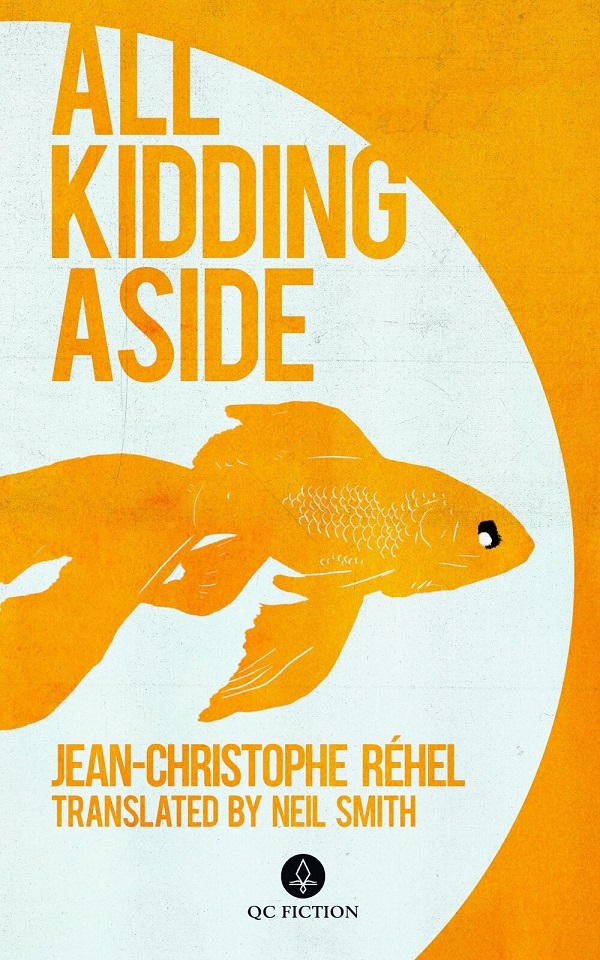
Jean-Christophe Réhel, All Kidding Aside, trans. Neil Smith (Baraka Books, 2025), 306 pp., $24.95.
Jean-Christophe Réhel is a young Québecois writer, known for his collections of poetry, his novels, his television scripts, and his columns (both poems and prose) in the Montreal newspaper Le Devoir. His first novel, Ce qu’on respire sur Tatouine was translated into English in 2020 as Tatouine, and was generally well received. All Kidding Aside is an English translation of his 2023 novel, La Blague du siècle.
All Kidding Aside takes place in a small section of Montreal’s east end called Pointe-aux-Trembles. The first-person narrator, Louis, shares his story with the reader: he has an unrewarding job at a Tim Hortons, a complicated home life with a dying father and a younger brother who also needs care and attention. He also has a strong interest in stand-up comedy, along with his own unrealized dream of being a comedian. And, if that isn’t enough, he experiences the loneliness of a young gay man several months after a breakup. Réhel is adept at capturing the nuances of the socio-economic circumstances Louis and his family endure, from just-missed buses to intrusive landlords and workplace friendships.
This novel does not have much of a plot. Indeed, after only a few short chapters, attentive readers could predict much of what happens to Louis and his family. The novel remains an enthralling read, though, because of the character of Louis himself. As readers, we see what he is doing, but also what he is thinking and feeling as he takes on the absurdities of his daily life. He comes across as caring and sensitive, (mostly) uncomplainingly shouldering his difficult responsibilities. He seems lovely, and as a result, reading the novel is a bittersweet pleasure.
Ironically, given such a strong first-person narrator, Louis articulates a key sentiment about the human condition early in the novel, as he waits for weekly comedy set to begin at a local club:
People start arriving, filling up the chairs and tables. Even though Bob is swamped with orders, he never loses his cool. Weirdly enough, we’re all a lot alike here. That lady sipping her gin and tonic near the stage, I’m her. That dude behind me pretending to listen to his friend, I’m him too.
Perhaps that is Réhel’s main gift as a writer: In Louis, he creates a character who is richly engaging and yet fundamentally banal. The other principal characters, whom we meet only through Louis’ narration, are his father and his brother. Both of them shine more brightly than Louis does, and neither seems likely to see himself as being like everyone else.

Jean-Christophe Réhel
Another major source of fascination in All Kidding Aside arises from the use of humour. Because of Louis’ interest in comedy, much of the novel features him watching and mastering routines by his favourite comedians, as well as his reflections on his own past and future stand-up performances. He attends a few comedy nights in local bars and develops a mini-crush on a fellow comedian, although he seems more interested in the material and technique than in the man himself.
This use of comedy could be compared to what is sometimes called “diegetic music” in films. Diegetic music is music that the characters in the film hear directly, when they turn on a radio or attend a concert, for example. Music soundtrack that enhances mood for the audience but is not heard by the characters, is known as “non-diegetic music.” Essentially, Louis and the other characters are aware of the stand-up performances as comedy, and they may laugh at it, and the reader is also able to laugh (or not) at the routines. Let’s call this diegetic humour.
Apart from the comedy performances in the novel, though, Réhel also creates a number of incidents that are potentially funny for the reader. There is a funeral, for example, in which a slapstick level of misunderstanding and mismanagement moves the narrative beyond realism. Bunches of flowers, estranged relatives, and an ice urn combine in a scene that would be at home in any screwball comedy. It is tempting to see scenes such as this one as examples of non-diegetic humour, and assume that the narrator of the novel does not realize that his family members are being depicted comically.
The complication, of course, is that All Kidding Aside has a first-person narrator who sees himself as a comedian. So we have to wonder whether Louis is directly sharing facts of his life with the reader, or the reader is watching Louis develop a stand-up routine inspired by his life. Part of Réhel’s success as a writer arises from the way in which he balances this ambiguity, inviting readers to shift back and forth between identifying with Louis and objectifying him. I hope that this does not give the impression that reading All Kidding Aside requires hard work. On the contrary, the novel is a fast and easy read, but it managed to stick around in my mind, playfully asking for attention after I had finished reading it.
Neil Smith, who translated this novel, as well as some shorter works by Réhel, is familiar with both the language and the cultural context of the original, and made the wise decision not to translate the numerous uses of calisse and esti and so on. Instead, he provides a brief afterword in which he explains the common ways in which Quebecois people swear. He also maintains the French-language song lyrics that appear within the text, but helpfully provides English translations in footnotes. Smith also includes a series of endnotes explaining references particular to Montreal or Quebec, such as UQAM, CHUM, Pinel and René Simard. As a result, the English text manages to be clear to anglophone readers, but retains a strong sense of place.
Because Plenitude is a queer literary magazine, I will note that Louis describes himself as gay, and has a friend who is described as lesbian, but the novel is not particularly concerned with sexuality or gender identity.
 Paul Leonard began a life-long habit of attending theatre in the 1970s. He worked first in theatre administration and then as a secondary school teacher until retiring in 2017. His writing has appeared in a variety of publications, including Canadian Forum, Epicene, Rites, and Canadian Theatre Review. He is a gay man living in Toronto.