 Reviewed by Leah Bobet
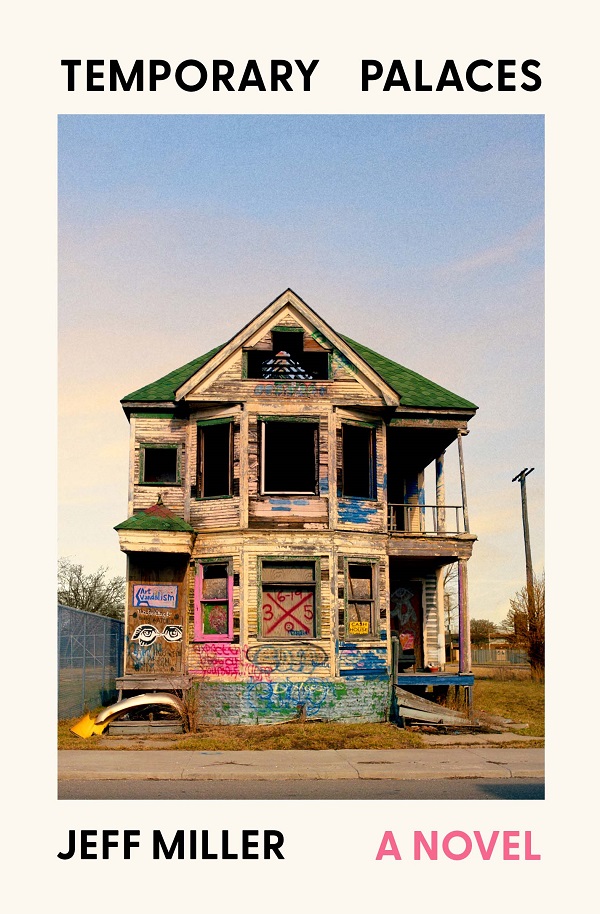
Jeff Miller, Temporary Palaces (House of Anansi, 2026), 320 pp., $26.99.
Temporary Palaces takes an intriguing twist on the CanLit formula: two thirtysomething artists reunite to excavate the broken promises and might-have-beens of the place that made them. Except Miller’s longform debut tackles a heady Ottawa punk scene caught in the last gasp of pre-9/11 activism.
It’s the sweaty summer of 2001, and punk musician Ben is in love with his bassist: shaggy-bearded, radically political, disturbingly manipulative Rob. He’s also got an impotent crush on Alex, a young photographer who’s built her punk show candids into a Vancouver MFA program acceptance. But Alex and Rob are also sleeping together, at least when Rob’s polyamorous girlfriend isn’t in town—and possibly so Alex will keep the free graphic design coming for Rob’s political-action group.
When Rob decides to lead an Occupy-style affordable-housing protest—and abandons the tour Ben built to get their band its big break—the consequences start flying. The cops are coming to evict Rob’s squat, all the people he’s sleeping with—and lying to—are comparing notes, and inevitably both the personal and political go directly to hell. By the time the squat is stormed and Rob vanishes, everybody’s plans have evaporated into the heat of a blackout summer.
Ten years later, Ben is still living in punk houses, co-running a local restaurant, and scrabbling after crumbs in nearly every relationship he has: from the band he’s perpetually begging for reunion gigs to the landlord who’s renovicted him, a long-distance girlfriend who doesn’t call, and a stray cat he’s rather tellingly named Rob. When he reconnects with Alex, now a Montreal installation artist who’s just won a major, life-changing prize, they resuscitate their old flirtation—and face down the impact of that one summer when Rob ostensibly changed who and what they were.
 But the energy that sparkles off Temporary Palaces’s synopsis somehow never connects on the page. Rather than the nostalgic evocativeness of dive bars, artists working on a shoestring, squat houses, DIY politics, and the energetic indie culture of the early 2000s, it unfolds into a curiously, relentlessly passive read that goes wildly off the rails when real power dynamics meet characters who don’t question or choose.
Some of the novel’s air of passivity is directly down to Miller’s oddly dissociative, uniform style. Whether it’s Ben or Alex—the book’s two narrators—declarative, rhythmless sentences march forward without flow or variation, sounding a surprisingly rigid drumbeat for a book centred around music.
Within those sentences lies a strangely baffled, helpless narrative worldview, deeply committed to describing and thinking about things by their outsides. People are exclusively described by their clothes, relationships by how they look, and worldbuilding by namedropping streets or song titles, dampening moments where a sense of place or atmosphere does build. This inevitably clashes with oddly fatuous love scenes where everyone “whimpers” with arousal, has a “powerful body,” or prefaces their kisses with a murmured: “Step into my world.”
Ben and Alex pinwheel between these extremes, either blank-faced or melodramatic in cities made of impermeable surfaces: nobody’s offering any internality, and nobody’s looking for it, either. Both Ben and Alex carry a matching streak of insistent, almost pathological passivity.
Ben’s incuriosity goes far past character arcs or personality quirks into truly self-destructive extremes. He knows nothing about the culinary industry when he’s part-owner of the restaurant consuming six days of his week. The minute someone sleeps with him, he “felt in that moment that he would follow her anywhere.” After one conversation in their rebooted friendship, Ben is somehow deeply petulant that Alex is talking with her other friends and not him. What starts as charming young indecision takes on the crawling undertones of codependency, as Ben perpetually compares himself to everyone around him and loses—and also insists on doing nothing about it.
With Alex, the implications are uglier. Her heterosexual crushes are laced with the same passive confusion and awe, but gender dynamics transfigure this into a sheer sexual servility that’s hard to stomach. Her emotional life is stereotypes of “bad boys,” housewife-like caregiving, and a blanket jealousy of other women; a place where men are sexy the moment they’re assertive, undesirable the moment they aren’t, and eroticism is dominance. The crowning moment of both Alex and Ben’s desire for Rob is the one where they “can’t resist,” or “all she could do was stare, hypnotized.”
As the resolution weirdly builds to lionizing Rob’s one halfway decent impulse as proof he did care, it casually and cheerfully chalks up all Alex’s hard work to his influence in a downright queasy version of epiphany. It’s how women talk in narcissists’ revenge fantasies: you’ll be sorry how you treated me when I’m gone.
It’s also a magnetism that Rob can’t quite live up to. Despite Temporary Palaces billing him as a sexually irresistible punk prophet brought low, Rob is not enough of a character to hold this book’s centre together. On the page, he’s just as opaque as every other force in this book: erratic, sulking, and clumsy-fingered in his sociopathy; relentlessly treating everyone like shit. No insights into why are sought or offered. To anyone with relationship experience, there’s little compelling mystery either: a standard-issue art-scene sexual predator, the kind women warn the new girls about. He’s not enough to build a book or a life-defining experience upon.
This bone-deep passivity and incuriosity have their cost: they undermine the very worthy themes Temporary Palaces tackles. It’s hard to excavate the precarity of relationships, ambitions, and communities with two characters who mostly avoid having them, or what success means when both failure and success are treated as random encounters, crashing into their victims’ lives: opaque, incomprehensible, illogical, and undeserved—either a rescue or a violation. A chance to resurrect one’s smothered punk band, reignited relationships, a major art prize are all treated with the same baffled dissociation for characters who everything just happens at; who rarely do anything but notice which song is on. “I don’t know what happened,” is Ben’s only comment on a long-awaited piece of good fortune. Temporary Palaces never considers that perhaps he ought to ask.
At its best, Temporary Palaces reads like an adulting-themed cozy apocalypse: a faintly comforting, low-stakes gesture toward housing scarcity, broken dreams, and repair, where problems can be solved offscreen and survived, people don’t get too hurt, and ultimately you can get different versions of what you want. And it’s a book that really does love music: the one place Miller’s prose visibly brightens. Running through the sway of a song, taking on flow, volume, metaphor; it’s the one consistent moment when the energy it’s promised connects.
But at worst, it’s an oddly dissociative read which can’t seem to express itself: where all the matter of relationships, the life and death of art scenes, ambition and ephemera are opaque smooth objects, catalogued from far away: never understood, and never understandable.
What results is a deeply mixed: accessible but difficult, vulnerable but oddly callous, asking worthy questions but rigorously undermining any attempt to answer them. I found myself wishing it had told me the whole story with the love, crackle, and courage it saved for music. On the dance floor, in this faded punk summer, apparently all the circuits connect.
 Leah Bobet’s novels have won the Sunburst, Copper Cylinder, and Prix Aurora Awards; her short fiction is anthologized worldwide. Her poetry has appeared in Grain, Prairie Fire, and Canthius, and has placed in the Muriel’s Journey Poetry Prize and the Rhonda Gail Williford Award for Poetry. She was the Utopia Award–winning poetry editor for Reckoning: creative writing on environmental justice’s 2021 issue and the longtime editor of Ideomancer Speculative Fiction. She lives in Toronto, where she makes jam, builds grassroots food security networks, and plants both tomatoes and trees. Visit her at www.leahbobet.com.