 Reviewed by Andrew Woodrow-Butcher
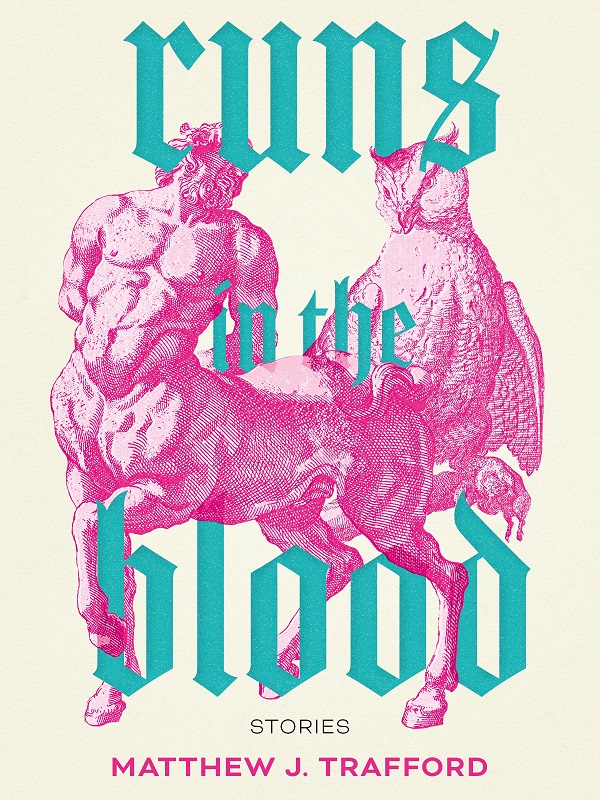
Matthew J. Trafford, Runs in the Blood (Arsenal Pulp, 2025), 184 pp., $21.95.
An older brother goes viral after murdering a dog. A stepfather’s homophobia rubs off on his gay stepson. A butch lesbian feels out of place at the princess party she brought her daughter to. These sorts of fraught, unsettling, and occasionally fantastical family situations are at the core of each of the dozen stories that comprise Matthew J. Trafford’s second short-fiction collection, aptly titled Runs in the Blood.
Brisk and involving, Trafford’s prose is flowing, even straightforward. But while the style is transparent, it conveys a sequence of punchy and murky emotional landscapes. This tension between the (seemingly) mundane and the larger-than-life, alongside his persistent themes of reproductivity (bio- or otherwise) and marriage, provides a strong throughline to a vibrant sequence of stories.
Most of the pieces in Runs in the Blood are realistic fiction, and though they are unlikely to elicit many out-loud laughs, Trafford infuses these works with an understated, absurd sense of both humour and irony. This is nowhere more evident than in “Something Adjacent to the F-Slur,” which takes place at a board meeting for a youth hockey league. Teenage Daniel was the one who uttered the offending epithet, and the organization must decide whether he can still be allowed to play. It’s Daniel’s mother’s first time at such a meeting, and we experience it through her eyes.
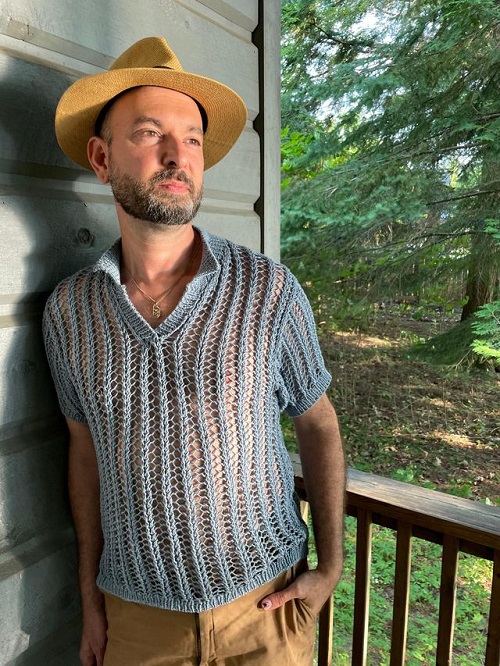
Photo credit: Thomas Trafford
This scene of a room of (presumably straight) administrators and fellow parents discussing (and reproducing) a homophobic incident in an attempt to get to the bottom of it manages to be frustrating, sad, and delightfully campy all at once. As the discussion meanders, Daniel’s mom recalls her life with Daniel’s father, her now-ex-husband Stanley, who himself came out as gay after the birth of their son. “Something Adjacent” offers a study in emotional counterpoint, and builds to a deliciously devastating, and very satisfying punchline.
But several of the stories in Runs in the Blood reach beyond this kind of realism toward the fantastical. In this vein, perhaps Trafford’s most audacious hook occurs in “Swipe Right for Chad.” The deadpan absurdity begins when the protagonist first encounters the titular Chad online, with only his waist-up profile pics to entice him. He swipes right for Chad. But all the enticing torso pics failed to flag the fact that Chad is a centaur.
As they meet at the Casa Loma stables for their first date, Chad’s new suitor takes in the full picture for the first time: horse-haunches, horse-cock, and all. (For his part, Chad is visibly offended by the suggestion that he might cover up with some shorts). A fraught, cross-species fling ensues, interspersed with the protagonist’s memories of his late (human) husband. This playful-yet-earnest, light-yet-heavy look at contemporary courtship is one of the most memorable pieces in the book.
“A Complete Index of How Our Family Was Formed,” for which the author acknowledges inspiration from American writer Matt Bell’s 2009 piece, “An Index of How Our Family Was Killed,” is a stand-out in a different way. Here, Trafford takes a formalist approach, using the alphabetical format of an index to compile the story of one couple’s blended family.
We read of adoption woes, grief, disability, unexpected inheritances, and legal troubles—and once again Trafford leverages the emotional gulf between the playfulness of the form and the heaviness of his narrative. These lighter aspects shine all the more because the affective foundation of Runs in the Blood is so serious—dark, even—both in its real and more otherworldly moments. And though subtle humour abounds even in these pages, so too do loss, anxiety, and alienation.
From the opening phrase of the opening piece—“Let’s make a baby”—to the book’s final fable of a raccoon family’s failure to reproduce, every one of these stories is about spousal and/or parent-child relations. This unity of theme contributes to the strong coherence of the reading experience, certainly. But given the largely queer cast, and the inclusion of narratives both realist and unreal, this restriction of the thematic palette is notable, and feels almost old-fashioned in its insistence and literalism. That said, these topics are obviously fertile ground for Trafford’s solid craft and powerful command of emotion—and, of course, parent-child and spousal relationships are resonant for many, even most readers. Runs in the Blood offers a compelling map of the ground within those borders, but not beyond them.
Bold and introspective, Trafford’s latest collection is a rewarding read that packs some surprising emotional punches. These studies of our contemporary world, along with the pieces that push beyond the limits of reality, comprise a meditation on the position of the self within one’s marriage, and within the course of generations. Runs in the Blood is sure to provoke and to illuminate.
 Andrew Woodrow-Butcher is an editor, critic, and consultant specializing in comics in schools and libraries. His work for the Toronto Comic Arts Festival spanned a decade and focused on programming for kids, educators, and librarians, and on building international comics partnerships. Andrew managed collection development services for The Beguiling Books & Art, where he also built their spin-off shop Little Island Comics, at the time the world’s only comic book shop just for kids. Andrew has written reviews and features about all kinds of books, for venues like Xtra!, Broken Pencil, Quill & Quire, CBC Kids, and Publishers Weekly. Currently based in Taipei, he consults for Kodansha USA, and is an editor at MSX: Mangasplaining Extra.