Interview by Loch Baillie
In this contributor spotlight, poetry editor Loch Baillie talks with Plenitude author Adam Arca about duality, mythology, and liberation movements, and how they converge with Adam’s poetry. Adam is a Filipino migrant rights organizer and writer living on unceded Musqueam territory (Vancouver, BC). A son to migrant workers from Bulacan and Cebu, their work is informed by care and liberation movements from Turtle Island to the Philippines. Their work has appeared in Briarpatch Magazine, amongst others.
Your poems “Stanley Park” and “Two Boys Kiss” were published in Plenitude in 2025, and each have a certain duality about them. In “Two Boys Kiss,” you write about the number two “As in a pair. As in a set. As in a couple.” and so on. In “Stanley Park,” duality is found throughout the poem as non-rhyming couplets. How did the forms for these poems come about and what role does duality play in your writing?
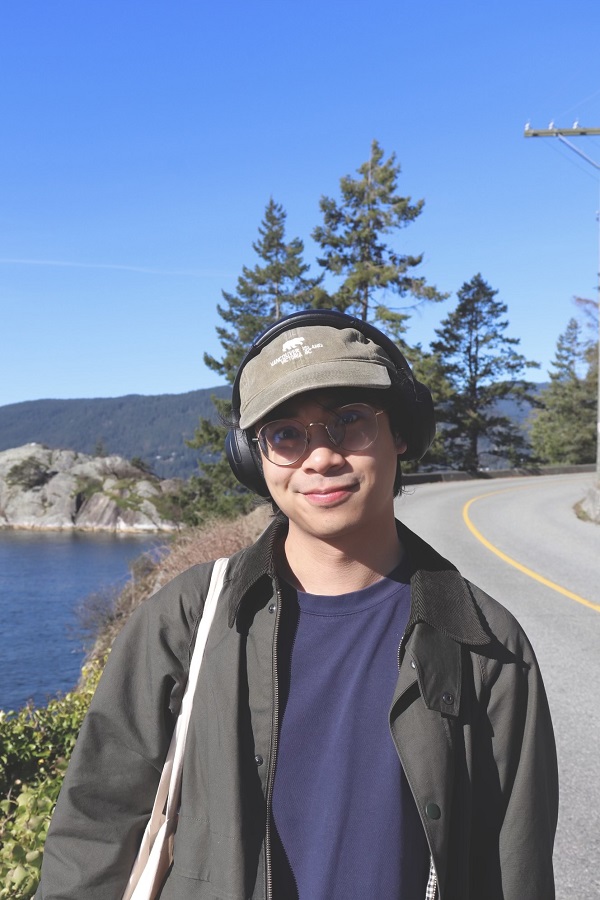 When I was making the first draft of “Stanley Park” and “Two Boys Kiss,” I was running off the thrill of being in love romantically for the first time and suddenly going from being independent and avoidant to any affection to “a pair.” “Stanley Park” was me trying to capture that motion, both within the literal imagery, but also in the couplets that almost stagger forward; how they force the reader to move, to stop mid-thought, to continue, to constantly re-orient themselves, because that’s how I felt biking on a cold sunny February day, watching as someone I love treads ahead of me, chasing them, despite the weight of the histories we both carry. The inspiration for the form of “Two Boys Kiss” came about from simply contemplating what the actual phrase “Two Boys Kiss” meant both linguistically and socio-politically. I wondered what it meant to dissect those words that, for so long, felt foreign and strange, especially as a second-generation Filipino growing up in white suburbia. The poem that followed was my natural conclusion.
It’s also interesting you ask about duality because it has always been an integral part of my writing approach. I write with the intention of naming the contradictions in things. I view my writing and my community organizing work in a sort of dialectical manner. I write because I am inspired by the people I organize alongside and fight for—the everyday migrant Filipino/a/x custodial workers, fast-food cashiers, nannies, nurses, construction workers—and my writing informs my organizing as I consolidate my people’s stories and find areas where I can improve to better serve them. I’m thinking about how we love despite violence, how we continue despite walls, how we choose to fight despite the systems of monopoly capitalism in place. The contrasting imagery of destruction, of gentrified landscapes, of decay, clashes against the tenderness found within human connection, of care, and struggle.
Towards the end of “Stanley Park,” you allude to certain myths and legends, such as Orpheus and parables. Are there any famous stories or cultural references that have influenced you or shaped you as a writer?
There are so many! Being a child of migrants, it feels like my whole life has been made up of stories my parents would tell me from their lives in the Philippines. The most memorable are the aswang, Filipino folklore monsters. One of them, the manananggal are these monsters (typically depicted as women) who shapeshift into vampires at night, sprouting large bat wings on their backs and severing half of their bodies, leaving their legs while their top half flies off and hunts for internal organs like intestines to feast on or the embryo of pregnant women.
In this story, the daughter in a family of manananggal hosts a sleepover with her friends at her place so her parents can eat them. But before that, they place a necklace over her neck to make sure they can distinguish her in the dark. When the time comes, they eat every child without the necklace, but as the sun rises, they realize that their daughter is gone. It turns out, before the girls went to sleep at night, the daughter had placed her necklace over her best friend to protect her. They had killed their own child.
It’s extremely morbid, yet like most stories of the Philippines, it is rooted in conquest, in Spanish colonial anxieties of rebelling women, a way to keep people scared and subservient to them. Even the word “boondocks” or “boonies” that refers negatively to a remote backwards area came from American soldiers traversing the archipelago’s mountains: the “bundok.” Sometimes, the stories we tell about each other, about our past, are also tools of control and suppression. It’s the kind that stick with me and the ones I want to refuse, screaming “fuck mythology”!
Throughout the final stanza of “Two Boys Kiss,” you use the poem’s title as a refrain. Aside from anaphora, what other poetic devices do you like to use in your writing?
Parallelism broadly is one of my personal favourite devices to use in any form of writing because of how you can skew or create new meaning with the same words or grammatical structure (my favourite user of it is James Baldwin!). But other than that, my roots are in spoken word, so I like to play around a lot with sound and pronunciation. Alliteration and onomatopoeia are two devices I employ instinctually when I write poetry. When I’m alone in my room, I usually will recite a poem out loud as if I’m in front of an audience. Language is so malleable, so it’s always fun to experiment with ways of shaping it on a page and how it can translate verbally.
Your author bio describes your work as being “informed by care and liberation movements from Turtle Island to the Philippines.” Are there any organizers or activists whose work particularly resonates with you and your writing?
Yes!
- Assata Shakur’s biography is some of the most visceral writing I’ve read that reminds me of why I organize and why I continue to tell stories about my organizing. In Assata: An Autobiography, she outlines her life from a young Black girl dealing with the contradictions between her family and environment to being a revolutionary in the Black Liberation Army to her exile in Cuba.
- In terms of Filipino organizers and activists, Jose Maria Sison comes to mind, who had his early start in cultural student organizations as an English major at the University of the Philippines and would become a leader in the national democratic revolution against American imperialism and state fascism amidst former dictator Ferdinand Marcos’ regime. His poem “I wish to be taken for granted” is one of my favourites.
- I also have plenty of fellow migrant rights organizers at Migrante BC who inspire my work, many of whom you will see me draw direct inspiration from the words I’ve heard in a meeting or at a rally. For me, it’s how they carry themselves, how they care and show up for others, how they invigorate me and stir me to be a better activist. My kasamas show up in all my writing. In fact, they are a part of why I write. Because they believed in what I do as not only a tool of literary quality, but as a tool to serve our community
Is there a particular piece of advice you have received from a teacher or a mentor that has influenced your craft?
I was a classic example of a queer kid who was close with their English teacher in high school. In my Writers Craft class in Grade 12 is where I really felt my words come to life. Ms. M, our teacher, was my number one advocate and supporter. I’m one hundred percent sure she knew I was gay because I was recommending her Call Me by Your Name after I had read the book and written a poem based on it. Most of all, I remember after our final spoken word showcase in the auditorium, she went up to my parents and I and told me to please “keep writing” after I graduate, no matter what. And I did, even when I was in my undergrad and even during my grad school degree that had nothing to do with creative writing. When I finally finished school, I had returned to writing stronger and surer of myself than I have ever been because I took that advice.
We’ve just entered the new year. What are you working on next?
I am currently working on a book-length non-fiction essay collection about migrant labour and organizing that collides the realities of Filipinos here with those within the Philippines, writing slightly happier gay poetry and drafting my first chapbook, still creating statements and doing political analysis for my organizing work, but overall, I’m really just wanting to create as much as I possibly can!
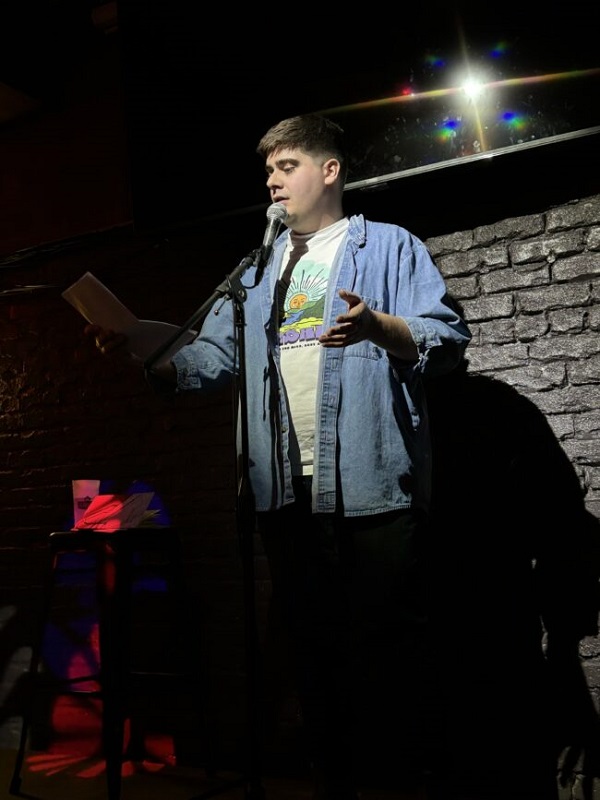 Loch Baillie (he/il) is a queer writer and editor based in Quebec City. He is the author of two poetry chapbooks, Citronella (Anstruther Press) and ice, dove, parachute (Cactus Press), as well as the full-length collection River Running (Goose Lane Editions). Loch’s writing has appeared in various magazines, including Maclean’s, yolk, LBRNTH, and Pinhole Poetry. He has served as a board director for the Quebec Writers’ Federation since 2025. An alumnus of Bishop’s University, Loch is currently continuing his English literature studies at the graduate level at Université Laval. Find him everywhere @lochbaillie.