Interview by James K. Moran
I do not position my writing as a literary landscape for readers to find themselves in. I don’t think artists should be hitched with the responsibility of being representational — Amber Dawn
Multifarious queer Vancouver author Amber Dawn defies easy categorization. An anthologist, novelist, poet, and memoirist, her work draws upon her own life as a former sex worker as much as classical writing forms. Queer artists coming up can look to, and perhaps see, themselves in Amber Dawn’s work, which spans more than two decades. In her latest poetry collection Buzzkill Clamshell (Arsenal Pulp Press), Amber Dawn explores chronic pain erotically, drenches certain poems in an ethereal, supernatural tone, and makes deep-cut horror-flick references. Frequent Plenitude contributor—and fellow poet and author—James K. Moran caught up with her via email for a wide-ranging conversation about cultural cross-pollination, literary craft, and queer preternatural pleasure.
James K. Moran: First, congratulations on poetry collection number three, Amber Dawn. How has reception been, from the mainstream press, and the queer press?
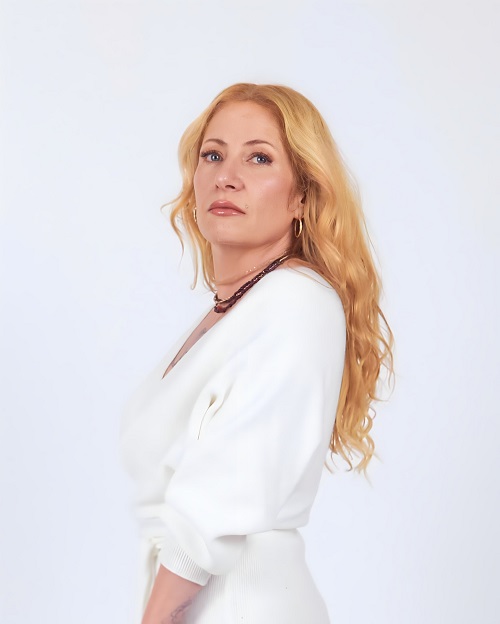
Photo credit: Amber Dawn
Amber Dawn: I was incredibly moved by the [April 4, 2025] review Margo LaPierre wrote for PRISM international, “Teeth, Guts, and Growths.” Margo could write a meaningful review for just about any poetry collection; she’s such a beautiful and dependable close reader. But, I swear, my review was special. Regarding my use of language and sound, she said I have a “ludic tongue”—how flattering! It only takes one reviewer to truly get my verse for me to be happy with the reception.
In 2015, Lucas Crawford reviewed a single poem of mine for subTerrain’s Line Break blog, titled “How a Poem Reads: Lucas Crawford on Amber Dawn’s ‘Chicken Dance.’” Lucas was, perhaps, one of a very few people that caught on to all of the poem’s allusions, including a nod to Gertrude Stein’s [1914 collection] Tender Buttons.
In both reviews, spaced a decade apart, I felt seen. This is the power of being reviewed by other queer poets. There’s a depth of shared insights that I am grateful for.
JKM: I hear you. You have proven your literary street cred many times over with novels, short stories, even memoir and, of course, supernaturally tinged erotica. So why poetry for Buzzkill Clamshell?
AD: I find it funny when people ask me, “Why poetry?” Poetry is limitless. Poetry is far more gymnastic than prose. Poetry is always an experiment. Or a letter. Instructions. A treatise. A portal. A disruption. A discomfort and a pleasure—at once. A siren and a lullaby—at once. Poetry is delicious speculation.
I get what you’re asking, though, why poetry (versus prose) for Buzzkill Clamshell? Is there something about my themes of the chronically pained body and queerness that are best explored through poetry? Yes. Poetry’s modes of inquiry are not about a who, where, what, why, when, and how. Poetry isn’t about a so-called accurate retelling of events or incidents. This can come up in poetry, for sure. But poetic inquiry is also about sound, rhythm and language, repetition and patterns, and all the finer elements of craft that makes you want to hear a poem read aloud. I find practicing the finer elements of craft very comforting. Clinical studies show that actively writing poetry can lower pain scores—I believe this to be true.
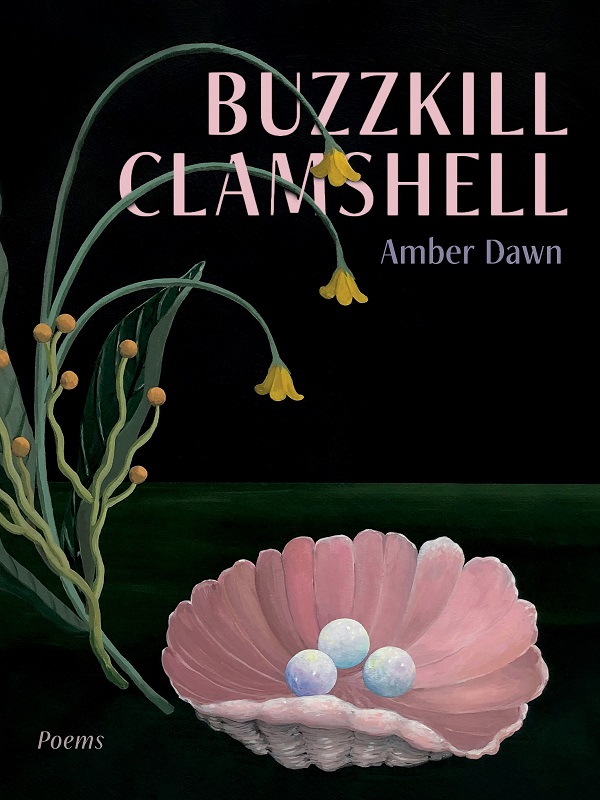 JKM: You must have favourite poems in Buzzkill Clamshell. Care to name any?
AD: Trying out the ancient Italian forms seemed apt as much of the mythology in Buzzkill Clamshell has Italian origins. I wrote these poems during some of the more isolating and frustrating times of experiencing chronic pain; rhyme schemes and syllable counting provided a distraction. It was also wonderfully humbling to work in forms that are hundreds or thousands of years older than me. My favourites are “Francesco del Cossa: Santa Lucia of Syracuse, 1472,” which is a Canzone that uses Dante’s rhyme scheme: abbc deec cffcgg. “Swan Maiden” is an unrhymed villanelle; A1 b A2 / a b A1 / a b A2, etc. “Buzzkill Clamshell ISO Goddamn” and “Lewis Carroll Could Never” are barzellette. “Canidia” and “Henry Fuseli: Titania and Bottom, 1790” are [each] a play on Fescennine Verse. Fescennine Verse is the oldest known form of Italian poetry, and it was often satirical and raunchy—the Romans actually made it illegal to perform Fescennine Verse.
JKM: I like Buzzkill Clamshell because it cuts to the core of pain, and does not look away. There’s erotic pain in there, and horror, and love, and intertextuality. The collection defies classification. You’re messing with form, free verse, and etymological references—with asides to the reader. I adore how sometimes you break the fourth wall to directly address the reader, questioning whether you should have included the poem or what you intended the poem to do. “Unfinished Poem” is a great example of this, and yields startling insights about queers claiming our own space.
AD: “Unfinished Poem” is an homage to shuttered queer clubs and parties. To me, the constant loss of spaces where queer people can more freely express bodily autonomy and physical desire is not at all separate from surviving chronic pain. Both the queer body and the queer space are landscapes of joy and complexity and defiance.
JKM: I dig the thick horror-movie references, including A Nightmare on Elm Street and the Hellraiser franchises just to skate across a few. From one queer horror fan to another, what are some of your favourite horror movies from the past few years? I’ll go first: It Follows, The Babadook, Sinners, Call Girl of Cthulhu, Cold Flesh, Suitable Flesh, Trick ’r Treat, Scouts Guide to the Zombie Apocalypse.
AD: Sinners feels like Ryan Coogler’s magnum opus to me. Never has there been a vampire film with such a high level of character development and engaged emotional connection between characters—not to mention the music and visual storytelling. It’s definitely my favourite in the past couple years.
The Fear Street series [on Netflix] introduced a new campy romp, Fear Street: Prom Queen, this year. Not the best of the series. However, there are many toe-curling kill scenes to enjoy. For anyone who loves the intersections of supernatural and slasher (with a generous side of horror parody), I recommend it.
JKM: I also reference Henry Fuseli’s painting in my own spec fic. The 1781 oil painting, The Nightmare, in particular. What about his work gets to you?
AD: I veered away from the iconic The Nightmare and instead chose to write an ekphrastic poem about Fuseli’s Titania and Bottom. This is one of two poems that are about a visual artwork. “Aubrey Beardsley: The Burial of Salomé, 1893” is the other one. In turn, these artworks are a response to theatrical productions—Shakespeare’s A Midsummer Night’s Dream and Oscar Wilde’s Salomé. And, in turn, those theatrical productions are based on ancient stories—Greek mythology and biblical. I love when different disciplines of art speak to each other, especially over such a long period of time. Almost like a chain letter (without the superstition) or a creative time capsule. In Fusilli’s painting, Titania’s pose was inspired by Leonardo da Vinci’s Leda and the Swan—another human/supernatural animal coupling. So there really is a queer dialogue going on, and on and on.
Both the queer body and the queer space are landscapes of joy and complexity and defiance — Amber Dawn
JKM: In your memoir, How Poetry Saved My Life, you describe getting your start as a writer, first finding poetry. Please tell me about a time when you read a poet, and saw yourself in the work.
 AD: I was very inspired by the [2010 Saturnalia Books anthology] Gurlesque: the new grrly, grotesque, burlesque poetics edited by Lara Glenum and Arielle Greenberg. It introduced me to the idea that one could write feminist literature while being irreverent about femininity at the same time.
JKM: Have you had queer artists looking to you for advice? There’s only one Amber Dawn, but you have shown them what is possible.
AD: I’m not open for free advice right now. I’m into protecting my health and capacity. Anyone seeking advice should be very mindful of what they are asking and of whom.
I have advice on how to ask for advice, though. I’ve learned that some of the artists I most look up to are, behind the scenes, struggling. I respect the artist and the struggle.
When I reach out to colleagues for advice, I practice the following:
- I am specific about why I am contacting them. As in, I understand their area of expertise, and I’m not just casting a wide net for general advice
- I make sure to acknowledge that they might not be able to respond
- I offer some kind of reciprocity (monetary, making a donation somewhere, helping them promote something, or writing a Goodreads review for their latest book, etc.)
- I am clear and focused in my ask. I do not ask big, general questions, like “How do I get published?”
- Most important, if the artist cannot respond to my request for advice, I make sure to follow up and thank them for their time anyway.
JKM: I want to circle back to your earlier comment about the reviews of your work by Margo LaPierre and Lucas Crawford. Although they were spaced a decade apart, in each case you said you felt seen. In your experience as a queer poet and writer, do readers approach you feeling seen in your work?
AD: To feel seen in literature—or any artform—can be a powerful touchstone. One of the greatest things about being a creative-writing professor is introducing students to literature that speaks to them. Could they be looking for experimental dark fantasy-esque written by a queer author? Great, here’s Carmen Maria Machado or K-Ming Chang. Are they looking for multilingual free verse poetry that interrogates colonialism? Great, here’s Noor Ibn Najam or Louie Leyson or Samantha Nock. Do they need examples of writing trauma-informed braided personal essays? Great, here’s Jen Sookfong Lee or Alicia Elliott. It’s a kind of matchmaking, for me. It prompts me to actively and widely read, and to be constantly changing my in-class readings.
Conversely, I do not position my writing as a literary landscape for readers to find themselves in. I don’t think artists should be hitched with the responsibility of being representational. When a reader finds themselves in literature, including my writing, that is a very personal journey. Considering that I write about sexual violence, trauma, disability, sex work, and criminalized identities, I don’t always have the capacity to engage with readers in this personal and intimate way. I hope theirs is an affirming journey. That’s all.
Now, if a reader saw themselves in my writing as it related to craft, I’d be up for that conversation. For example, if a reader were to approach and say, “Wow, Amber Dawn, I didn’t know you could be a new formalist poet and still be such a filthy whore. Thanks for the inspiration”—that’s a conversation I could get into.
Buzzkill Clamshell (Arsenal Pulp Press) is Amber Dawn’s third poetry collection.
Reprinted with permission from Buzzkill Clamshell by Amber Dawn (Arsenal Pulp Press, 2025).
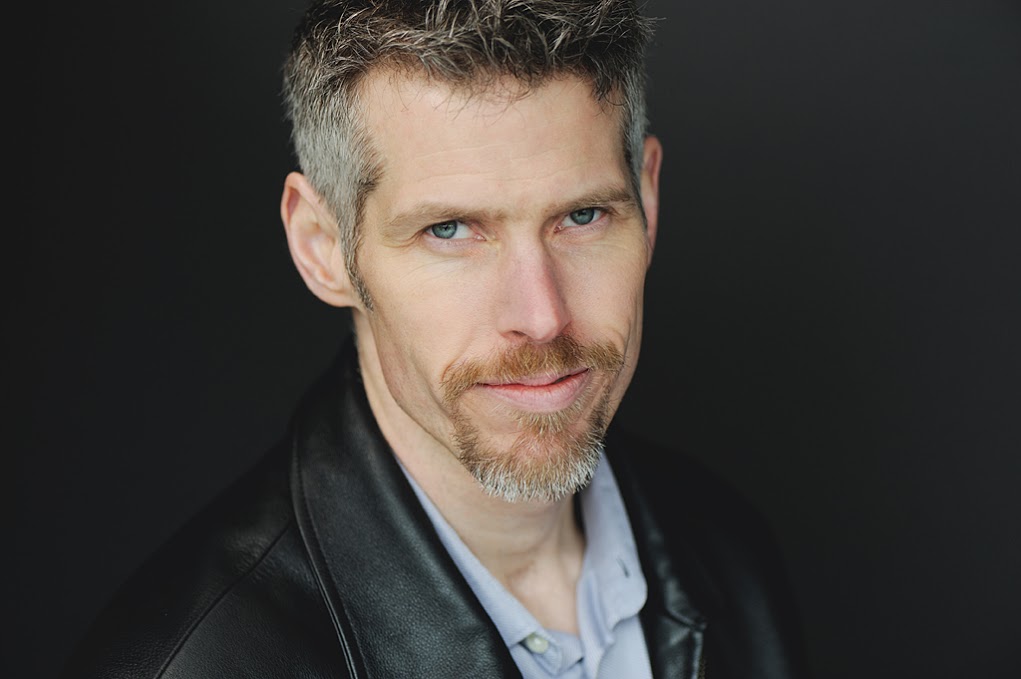 Ottawa’s James K. Moran’s speculative fiction and poetry have appeared in Burly Tales: Finally Fairy Tales for the Hirsute and Hefty Gay Man, Bywords, Glitterwolf, On Spec, and elsewhere. Lethe Press published his short-fiction collection Fear Itself, resplendent with queer characters, and his small-town Canada horror novel Town & Train featuring bi protagonist Constable David Forester. Moran freelanced for Xtra (née Capital Xtra! in 1993) for over 15 years. Find him at jameskmoran.blogspot.ca and reviewing for Arc Poetry Magazine and Strange Horizons. Also at @jamestheballadeer.bsky.social Bluesky and jamestheballadeer Instagram.