Jake moved his knight.
“How long are you going to drag this out?”
The angular black horse had a white scar in place of its left ear. This was the same set where one of the white pawns had vanished around the time Jake’s sister was born, and then been replaced with a wooden one on a slightly smaller scale. Our first Christmas together, I’d given him a limited-edition Iron Man chess set, which he’d loved. But this was the set that lived at the cottage, as familiar as a toothache.
There was probably a way out of a situation like this—somebody’s gambit or the someplace maneuver—but I was never actually very good at chess. I knocked my white king over. It rotated jerkily on its scalloped crown, then settled, exposing a green velvet base.
“Fine, you win,” I said. “What do you want to do now?”
He rose from the stool and stepped past the coffee table to lean against the arm of the couch. Suddenly, again, he was close enough that I could smell him. I looked at the upholstery, mustard-yellow with hard-wearing woven bears, and not at his thigh.
“I dunno. Want to get some exercise before we start dinner?”
My head snapped up. It hadn’t been that long, not really, since that question only ever meant one thing.
“What?”
He met my eyes and blinked. He still had that dark, freckly spot on his left iris, where the brown deepened almost to black.
I kept talking. “Because, I mean, we could. I would. Sam wouldn’t have to know. It wouldn’t have to mean anything. Just, like, for old time’s sake.”
I put my hand on his leg.
It was warm.
Under my fingertips, his leg hair felt just like I remembered.
He bolted upright and took a sharp step back, catching his hip on the bookshelf full of field guides and eighties Del Ray paperbacks and my copy of Anna Karenina from the Development of the Novel class, right where I left it after finals junior year.
“What the hell?”
Unlike the surroundings, his expression was unfamiliar. Shock. Disgust. Pain. I’d always liked how full his lips were. Now they were curled back, twisted.
My tongue felt gluey.
“I’m sorry—I thought—you said—”
“What the hell! Sam and I—I mean, we asked you to be in the wedding—I meant, like, let’s walk up to the quarry, not—I mean, Jesus!”
My face went hot. Something stuck in my throat.
“Yeah. No, yeah. I’m … yeah. Sorry. Yeah. I’ll take a walk and … and yeah.”
I grabbed my green Chacos and stumbled out the screen door, not stopping to put them on until I reached the gravel road. It was the last long weekend of the summer, stifling hot with no breeze. The cicadas screamed in the swampy air, begging to mate before they died.
I headed for the quarry alone. I should have known this was a mistake. Obviously Jake didn’t mean anything more than what he said by “Come anyway, for old times’ sake,” when Sam cancelled for the weekend.
At least I’d taken my own car. Fuck. I kicked the gravel and got a sharp pebble under my toe.
I could have found my way up to that quarry in my sleep. It seemed like a long walk the first time, when Jake invited a bunch of people up from the hall at the end of freshman year and we piled into two cars and nobody remembered sunscreen. I spent most of the weekend waiting for something to happen. So did he. We stayed out until three a.m. on the last night, watching fireflies and meteors but mostly each other. Before we kissed, he teased me about my freckles, and smeared aloe on my sunburn.
It didn’t seem like a long walk this time. The road faded from gravel behind the cottage to rutted grass past the hill I’d slid down trying to pick enough blackberries for dessert—they all spilled—and then to crusted mud in the hollow where the tumbling rill met the lake and I always startled a frog. I startled one now, a bullfrog from the size of the plop, and made myself stop and look out from the stepping-stones spanning the creek. They were dry now, though I knew they’d been slippery in the spring. They were slippery every spring, because they had to be low enough to drive the Jeep over, because no one wanted to put in a real bridge. I’d pointed that out to Jake when he told me he was going to take Sam up here to propose, and asked I thought if this would be a good spot.
I gritted my teeth and looked at the lake. The water was still, perfectly mirroring the fine-etched clouds in the sky above. Something was paddling near the shore on the other side, leaving ripples behind, but it was too far away to make out whether it was a loon or just a duck. I’d never heard a loon before Jake took me here.
The road started climbing again past the stepping-stones. The old quarry was dug into the side of a hill, sheltered from the lake breezes. The stone for the original cottage had come from it, though of course Jake’s parents had only kept the foundation when they redid everything. There was a pond there now, too shallow for swimming, but thronged with salamanders in the spring, and dragonflies now. I’d started spending every spare minute up there when I was taking Geology 101—“rocks for jocks,” everyone called it—to get my science requirement out of the way. What had been background scenery, just a rock bowl, slowly resolved into layers of Devonian sandstone and Silurian shale resting on a churning mass of migmatite and granite. I found fossils too, from when all this had been seafloor: knobbly coral fragments, limestone threaded with crinoids, slate stamped with ancient clamshell intaglio. No trilobites, though, no matter how hard I looked. I always wanted to find one.
Each fossil and mineral sample went, neatly labeled, into my final collection, landing me the one and only A I ever got in a science class. Jake never got tired of hefting the case and saying “What have you got in here anyway, rocks?” Somehow, I never stopped finding it cute.
The quarry looked the same, even more than the cottage looked the same. From here at the side of the gravel road, it could still be that first summer, or junior year, when Jake and I were still planning to find a place together after graduation. Before.
I walked around the pond to the wall on the other side, where a low stand of willows hid the sunny limestone shelf where we used to sunbathe naked. Among other things. I settled onto the warm rock and slumped over my knees.
It had all been going so well. Sam was great—everyone agreed Sam and Jake were great together—and of course Jake and I had stayed friends and that was great. When he got close enough that his familiar smell reached me, and I remembered how warm his shoulder was, I just leaned away. None of our friends had to choose. Sam and I got on so well—of course, we were both great—and Sam and Jake even wanted me in the wedding, and everyone was so relieved I didn’t make it weird at parties. I’d made it through two years of “I don’t think we want the same things” and “Thanks for being so cool about this” and “I’m seeing someone” and endless excruciating double dates with Jake and Sam and whoever couldn’t take my mind off Jake that month, and I had been just great.
And now, in one minute, I’d ruined it all.
I found myself on my feet again, staring through willow leaves and wet eyes at the sloping walls of the quarry.
“FUCK!” I yelled, loud enough to echo. A green dragonfly whirred up past my arm.
That wasn’t true. It had been ruined for years. I’d just been being great about it.
“Fuck,” I said again, more quietly.
I couldn’t face going back yet, so I poked at the scree along the base of the slope, throwing rocks at the pond. Black slate, red sandstone, gray and white migmatite folded like Damascene steel. They arced away from me one by one and vanished into the reeds. I picked up another one and turned it around in my hand, thumb riffling over an array of smooth ridges as I wound up. I stopped mid-throw, feeling those ridges again, and looked at the stone. Dark slate, with sharp edges. Frost weathering, probably fairly recent. And buried in the middle of it, something unmistakable.
I held it up to my face, which seemed to be smiling all on its own. The trilobite’s head was a sharply horned waxing moon. The rest was nearly complete, its small body cut off in a slate facet where it started to taper towards the tail. I used my nail to count its segments—tergites, they were called. I remembered because it always got autocorrected to termites. There were eleven. I stroked its back reverently. Hundreds of millions of years ago, this little animal lived and died at the bottom of the sea and turned to stone. And, through some alchemy of fate, it lay in my living hands. I was probably the first human who had ever seen it. Perhaps the first anything to see it since it died and sank into the mud eons ago.
I stood there, caressing it, until the sun was too hot on my skin.
“Okay,” I said, and slipped my trilobite into my pocket. “Come on.” It had been too long already.
When I got back to the cottage, Jake was in the kitchen in his noise-cancelling headphones, chopping vegetables and singing along to Zone of Totality. I recognized the album, of course. We’d listened to it so many times in the car together, driving out here.
I went up the stairs without catching his eye. When I arrived on Friday I’d gone, on autopilot, to put my stuff in the big bedroom, and only realized my mistake when I put my bag on the bed and seen Jake’s book on the nightstand I always thought of as mine and wondered why he was on the wrong side of the bed.
Now, I went straight to the small blue room with the rag rug and the birch tree near the window and started throwing things into my duffel. Dirty clothes. Clean clothes. Books. Cables. Shoes. I checked the nightstand drawers—empty—and the closet—raincoat—and yanked the sheets off the bed. Then, the bathroom across the hall. Toothbrush, toothpaste, meds, bug repellent, straight into the toiletry bag. Toiletry bag, straight into the duffel.
I pulled the trilobite out of my pocket and ran my finger across its back again. They used to be everywhere. For hundreds of millions of years. And then everything changed, and they were gone. The stone animal in my hand belonged to a world that no longer existed.
I made myself take a breath and do a last sweep. I wouldn’t be coming back here again. Then, I grabbed my duffel, took another breath and went down the stairs.
I hadn’t left anything in the kitchen or the living room. Well, the ice cream and the beer, but Jake could keep those. Rocky Road was his favorite, not mine. I stopped by the screen door, bag in hand, and waved to get Jake’s attention.
He slid his headphones around his neck, eyebrows pinched with concern.
“What are you doing?”
“I’m gonna go.”
“But—no, look, I’m sorry, you don’t have to—”
“I really do.”
Maybe when I got back to the city I’d call my dad, ask if I could come out west and stay for a few months. Find a job out there. Meet some people. I’d always wanted to learn to surf.
“Yeah. Okay. But I’ll see you next week? We still want you to be in the wedding.”
My palm was sweating around the duffel’s handle.
“I’ll be at the wedding.”
He stared at me, a lost, puzzled look on his face. And suddenly, I didn’t want to kiss it better, or hold him, or anything like that. The look on his face wasn’t my problem anymore.
“Well, bye,” I said. I walked out the door, tossed my bag into the backseat, and backed out of the driveway before I could lose my nerve.
I drove slowly, tracking the brown limestone and red granite under the scraggly pines. The limestone had once been mud. Eventually, with enough pressure, it would be marble. The years piled on, and everything stayed the same. Until it changed.
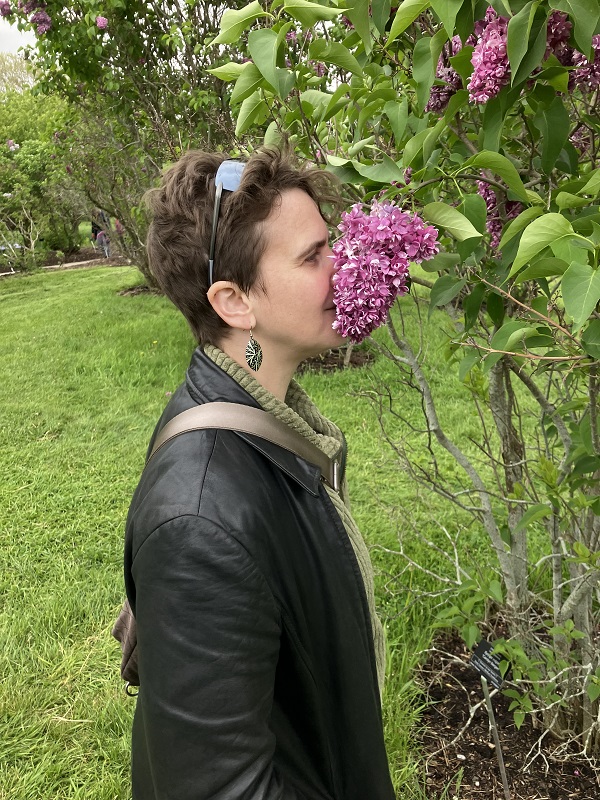 J. L. Rifkin is an author and scientist living in Toronto with one historian, two cats, and innumerable spiders. Their fiction has appeared in Roses & Wildflowers and On Spec, and their nonfiction has appeared in Evolution and in Molecular Ecology. The fiction is usually more fun.